Appraisals for Partially Covered Insurance Claims

September 15, 2026, by Aaron Jacob, Esq.

When your insurance claim is covered under your policy, but you and your insurer disagree on the size/extent of the loss, the appraisal process is an effective way to resolve the dispute without going to court. However, when a loss is only partially covered, some insurers may try to avoid the appraisal process on the parts of the loss that are otherwise covered and ripe for appraisal. New York courts have provided useful examples to help distinguish when appraisal is appropriate or premature for these types of claims.

Appraisal Overview

  • Appraisal is a dispute resolution process designed to give policyholders and insurers a neutral way to evaluate and determine the scope of a loss and the extent of damages. In the property insurance context, appraisal is typically used in first-party claims, e.g., claims submitted directly to one’s own insurer for a loss of one’s own property or for related damage.
  • Issues that can be resolved through Appraisal: The appraisal process can resolve a wide range of issues, including the scope of damage to real or personal property, the period of restoration, replacement cost value of property, actual cash value of property, demolition costs, the extent of a business interruption loss1, code-upgrade costs, rental income loss, mitigation costs, additional living expenses2, etc. In short, appraisal is an appropriate tool to resolve any dispute between an insurer and a policyholder over the “dollar value of the insurer’s liability” for a covered loss.3 In New York, this can include the value of loss, or the scope of a loss.4
  • Valuation vs. Coverage: Appraisals are strictly used to determine the amount or extent of a loss, but they cannot determine whether the underlying claim is covered under your policy in the first place. However, New York case law sometimes has allowed appraisal panels to untangle factual causation questions directly tied to the specific scope of damage.
  • Triggering the Clause: Either party can demand an appraisal if there is an unresolved disagreement over the extent of a loss, repair costs, or property values. The demand must usually be made in writing, and the steps are outlined in standard New York fire, property, and auto policies.
  • Selecting Appraisers: Both you and the insurance company hire and pay for your own independent, competent appraiser. The two appraisers then select a third neutral umpire. The three-person panel then evaluates the loss and determines a value.
  • The Appraisal Award: So long as the panel stayed within the scope of what it was asked to decide, an appraisal award is binding on both a policyholder and the insurer. A court will very rarely modify or vacate the award unless there is a showing of “fraud, bias, or bad faith.”5 This standard has been applied consistently and is a difficult burden to prove.

How Appraisal Works

Triggering a Demand

How to trigger the appraisal process is outlined in your insurance policy and in state law. New York, for example, has codified the appraisal process in Insurance Law § 3408.6 This statute governs the umpire-selection procedure and lets either party apply to court to compel appraisal when the amount of a loss is disputed.

The process almost always requires a written demand, which can be made by either the policyholder or the insurer. After a demand is made, each party selects its own appraiser, and the two appraisers then select a third, neutral and disinterested umpire. The three-person panel “determine[s] the actual cash value, the replacement cost, the extent of the loss or damage and the amount of the loss or damage…”7

Timeliness: Don’t Wait Too Long

The right to demand an appraisal isn’t unlimited in time. Under New York law, it must be exercised within a reasonable period, and what counts as “reasonable” depends on the facts of the case.8 A party can waive its right to an appraisal if it waits too long to demand one. Insurers often claim that an insured waited too long after a loss to demand an appraisal. Another risk of waiting, and another common excuse used by an insurer, is that the damaged property was removed, destroyed, or repaired before it can be inspected, and that appraisal is no longer practical.9

That said, courts have been reluctant to find an appraisal demand untimely just because some repairs had already occurred, particularly where the insurer suffered no real “prejudice.” For example, even a late demand can be proper where an insurer had early notice of the loss and the insurer had an opportunity to inspect and photograph the property shortly after the loss.10 A demand can even be made after litigation has already begun, with courts assessing reasonableness on a case-by-case basis rather than applying a hard cutoff.11 Therefore, a mere delay, standing alone, will not waive the right to appraisal, absent actual prejudice to the insurer.12

The Line Between Valuation and Coverage

Before an insurer will pay for any claim, the loss must be covered under that policy of insurance. Coverage issues are when there is a question or a dispute on whether a given loss is covered under the policy in the first place.

While appraisal is a powerful tool for resolving disputes over the value of a loss, the procedure is only proper when a loss is covered under a policy of insurance. The procedure is not available when there is a genuine question about coverage for the loss itself. That’s because the extent or valuation of damage is a factual question appraisers can decide, while coverage is a legal question that usually requires a court or arbitration panel to resolve. This distinction is made clear in New York Insurance Law § 3408(c).13 So, if a coverage dispute exists for a loss, it generally must be resolved before the loss can go to appraisal.14

Entire Claim Denial

An example of an outright denial and a coverage dispute over an entire loss can be seen in Kawa v. Nationwide Mutual Fire Insurance Co.,15 a case where there was a coverage dispute over what caused the damage to the aluminum siding of an insured’s house. In Kawa, a homeowner’s aluminum siding was damaged after a windstorm hit the property. The homeowner demanded an appraisal to determine how much repair work was needed for aluminum siding. However, the insurer took the position that the damage to the siding was not caused by the windstorm at all, but rather by age, wear and tear, and prior improper maintenance, all excluded causes of loss under that policy.

The Court in Kawa held that because the insurer was disputing whether the storm caused the loss in the first place (i.e., a coverage issue), and not simply how much it would cost to fix the damage from the storm (an issue for appraisal), the dispute went to liability itself, and the appraisal clause didn’t apply until the issue of coverage was resolved.

Notably, Kawa involved a dispute over what caused the entire loss, so appraisal was not appropriate. As discussed below, Kawa is distinguishable from cases where coverage issues exist on only part of a loss or cases where the insurer only claims that there are coverage issues.16

Partial Claim Denials & Pretend Coverage Disputes

The distinction between claims that are ripe for appraisal and those that are not gets murkier still when a loss involves both covered and potentially uncovered damage. Under New York law, when a claim contains both covered and potentially uncovered elements, appraisal generally remains appropriate for the covered portion of the claim. Insurance companies, however, will often try to blur this distinction to refuse or delay appraisal, even where appraisal is otherwise proper for the covered part of a claim. New York courts have repeatedly pushed back on that tactic.

Pottenburgh v. Dryden Mutual Ins. Co.: Claimed Coverage Issues

In Pottenburgh, a homeowner returned from a weekend trip to find the inside and outside of the house spray-painted with vulgarities. He reported the loss to his insurer, and the insurer inspected and photographed the damage within weeks. The homeowner’s public adjuster valued the loss at roughly $81,870 while the insurer’s own estimate came in at about $37,986.17

The homeowner demanded an appraisal to resolve the difference between the two estimates. The insurer refused to participate in appraisal, arguing the dispute wasn’t really about the amount of the loss, but rather about coverage. In this regard, the insurer claimed that the homeowner’s estimate reportedly included items the insurer said weren’t vandalized at all: a fireplace, garage siding, a bathroom, and portions of the plumbing and electrical systems. The homeowner countered that these items were included in the estimate not because they were independently damaged by the vandalism itself, but because properly repairing the indisputably vandalized portions of the house required repairing/replacing these other items too. For example, the homeowner argued that replacing the fireplace was necessary because an exact match for its damaged glass doors couldn’t be found, or that re-siding an entire wall was necessary because replacement siding couldn’t be matched to the weathered, undamaged siding beside it.

The Pottenburgh Court sided with the homeowner. In its decision, the Court held that because the insurer had never actually denied coverage for the vandalism claim itself and never identified any policy language that the Court would need to interpret, the dispute was really about the extent of work needed to fix a loss that was indisputably covered under the policy. The Court held that this is the kind of factual question that falls “squarely within the scope of the policy’s appraisal clause.”

Rivas v. United States Automobile Association: Partially Covered Claims

Rivas,18 a 2025 Supreme Court decision, illustrates that an insurer’s partial denial does not excuse it from appraisal on the covered portions of a loss. In Rivas, a homeowner’s house was damaged when a pipe froze and burst. The insured submitted a claim for approximately $187,000, covering repairs to the bathroom, closets, stairs, bedrooms, and floors, as well as personal property and living expenses. The insurer offered only about $11,000 and issued a partial denial limited to damage to the stairway carpet, a small piece of the overall claim.

The insured demanded appraisal for the covered damage (i.e., everything but the stairway carpet), but the insurer refused, pointing to its partial denial letter. The Rivas Court correctly sided with the policyholder and compelled the insurer to participate in appraisal, noting that the appraisal demand excluded the stairway carpet (the one item with a genuine coverage dispute) and incorporated only the undisputed, covered portions of the loss, which made up the bulk of the claim.

Louati v. State Farm Fire & Casualty Co.: Concurrent Live Coverage Issues

The 2018 decision in Louati19 is a case which shows that appraisal can remain available even alongside a live coverage dispute. There, a policyholder suffered water damage to their property, and the parties disagreed over whether the damage was caused by a burst pipe (a covered cause of loss) or by another, excluded cause. They also disagreed on whether it was necessary to re-tile the entire first floor when the water loss had directly affected only the bathroom.

The policyholder sought appraisal; the insurer opposed it until the causation issue of the loss could be resolved. The First Department agreed that while the issue of causation needed to be resolved first, the separate question of “whether it was necessary to re-tile the entire first floor” presented “factual questions that are properly decided in an appraisal.”

Laxminarayan Lodging v. First Specialty Ins. Corp.: Dressed Up Valuation Dispute as Coverage

A 2023 decision from the SDNY shows just how far some insurers will go to dress up a valuation dispute as a coverage dispute. In Laxminarayan Lodging, LLC v. First Specialty Insurance Corp., the insurer identified six supposed “coverage issues” standing in the way of appraisal: (1) whether physical loss occurred during the policy period, (2) whether the loss was a “prior loss,” (3) whether a wear-and-tear exclusion applied, (4) whether the roof’s age limited any recovery to actual cash value, (5) whether a cosmetic-damage exclusion barred coverage, and (6) whether the roof’s age barred recovery altogether.20

The court wasn’t persuaded. The Court held that because the insurer had already conceded partial coverage, the first issue wasn’t a live dispute at all. Additionally, none of the remaining five actually required the court to interpret any policy language, because the parties agreed on what the exclusions meant and on how old the roofs were. Rather, the policyholder and the insurer’s actual disagreement was which storm caused which damage, and how much that damage was worth. That, the court explained, is a causation dispute, and “apportioning damage causation” is “essentially a factual question” for an appraisal panel, not a legal one for the court.21

What You Need to Compel Appraisal in Court

If your insurer refuses to participate in a properly demanded appraisal, New York courts have identified what a policyholder generally needs to compel the insurer to participate: (1) a policy that contains an appraisal provision; (2) damage to property covered by that policy; (3) submission of a claim arising from the loss; (4) a genuine dispute between the parties over the value of the damages; and (5) a demand for appraisal that the insurer has refused.22

Notably, a policyholder does not need to itemize every specific area of damage underlying the disagreement to get the appraisal process started. Neither the applicable statute, case law, nor the required policy language requires that level of detail up front. Moreover, courts have treated an insurer’s own claims-handling conduct, such as making a partial payment offer during adjustment, as evidence that the real dispute is about amount, not coverage.23

However, greater detail may be recommended in claims where there are genuine issues of coverage on part of a claim. In those cases, your demand should specify that the appraisal is only demanded on the covered portions of the claim and not for the parts of the claim that have coverage issues.

* * *

New Jersey Considerations

In New Jersey, like in New York, the appraisal process is a helpful tool that can be used to resolve disputes between an insured and its insurer in claims for property loss. Briefly,

  • New Jersey law requires that all fire insurance policies contain the same or a more favorable appraisal provision that is outlined in N.J. Stat. Ann. § 17:36-5.20. The appraisal process in New Jersey has many of the same rules and restrictions as New York’s appraisal process but also differs in some places.
  • The mechanics of the appraisal process in New Jersey are similar to the process in New York. In New Jersey, after an appraisal demand is made in writing, each party selects their own appraiser, and then the two selected appraisers select a third neutral umpire. The umpire then hears both appraisers and reconciles the differences as they see fit.24
  • Under New Jersey law, similar to New York (but not identical), appraisal can only be used to resolve a dispute as to the amount of a loss but cannot be used to make legal determinations such as coverage issues or causation.25
  • Key Difference in New Jersey: New Jersey courts26 have held that the appraisal process “was not intended to resolve disputes as to the extent of damage, the scope of work required, or the cause of the damage, but rather, only for the amount of the loss.” New Jersey courts therefore differ from New York in that the former have held that “causation” (a legal issue) includes the “extent of damage sustained” from a loss.27
    • Stated another way, in New Jersey, the question of what portion of the damage to an insured’s property was caused by a covered cause of loss is ultimately a coverage issue and not appropriately decided during appraisal.28 In New Jersey, appraisal is only appropriate where “there is no dispute as to the extent of damage or the scope of work required.”
  • In New Jersey, ongoing coverage issues on part of a claim, or even the entire claim, do not prevent an appraisal from going forward, nor do they preclude either party from invoking the appraisal process.29

* * *

Aboulafia Law Firm LLC works exclusively on behalf of policyholders and has decades of experience fighting insurance companies. Whether you are dealing with a residential or commercial property claim, we are ready to help you. If you are dealing with property damage in New York, don’t navigate the complex claims process alone. For assistance on your insurance claim, please contact us.

The opinions expressed are those of the author(s) and do not necessarily reflect the views of the firm, its clients, or any of its or their respective affiliates. This article is for general information purposes and is not intended to be and should not be taken as legal advice.

Aaron Jacob is a senior associate at Aboulafia Law Firm LLC. Mr. Jacob is a skilled litigation and coverage attorney and has extensive experience representing commercial and private clients involved in property damage and insurance coverage claims in complex state and federal court matters.

Mr. Jacob focuses his practice on advocating for policyholders in high-exposure property damage cases, insurance recovery claims, coverage disputes, construction-related claims, declaratory judgments, first & third-party claims, business interruption losses, indemnification, additional insured coverage, broker negligence, risk transfer, contractor/subcontractor liability, bad faith claims, contribution claims, breach of contract disputes, and general liability defense, as well as in litigating insurance coverage issues under several policy lines including homeowners, commercial liability, excess/umbrella, businessowners, cargo, freighting, and commercial auto policies.


Footnotes

1. e.g., loss of profit that resulted from another event. ↩

2. See Olson v. E. Mut. Ins. Co., 41 N.Y.S.3d 658, 659 (N.Y. Sup. Ct. 2016) (personal property); Lyden v. Fazio Storage Warehouse Co., 143 N.Y.S.2d 460 (Sup. Ct. 1955) (same); Ram Krishana Inc. d/b/a Motel 6 Sulphur v. Mt. Hawley Insurance Co., 2025 WL 371016, at *3 (S.D.N.Y. 2025) (NY law) (mitigation costs); Woodworth v. Erie Ins. Co., 743 F. Supp. 2d 201, 218 (W.D.N.Y. 2010), on reconsideration in part, 2011 WL 98494 (W.D.N.Y. 2011) (additional living expenses); Duane Reade, Inc. v. St. Paul Fire & Marine Ins. Co., 279 F. Supp. 2d 235, 241–42 (S.D.N.Y. 2003), aff’d as modified, 411 F.3d 384, 399 (2d Cir. 2005) (duration of a business-interruption restoration period, once defined, is a valuation matter). ↩

3. See Schmid v. Allstate Ins. Co., 2017 WL 6994547, at *6 (S.D.N.Y. 2017) citing Zarour v. Pac. Indem. Co., 113 F. Supp. 3d 711, 715 (S.D.N.Y. 2015) (NY law). ↩

4. Pottenburgh v. Dryden Mut. Ins. Co., 55 Misc. 3d 775, 776–778, 48 N.Y.S.3d 885, 886–888 (N.Y. Sup. Ct. 2017). New York differs from New Jersey in this respect. In New Jersey, only value of a loss is appropriate for appraisal, while scope of a loss is not. See, German Auto. of Tinton Falls, Inc. v. Harleysville Ins. Co. of N.J., No. A-2571-13T3, 2014 N.J. Super. Unpub. LEXIS 1952, at *6 (Super. Ct. App. Div. July 29, 2014). ↩

5. Forbes v. Cendant Corp., 205 F.3d 1322 (2d Cir. 2000); Coral Crystal, LLC v. Fed. Ins. Co., No. 17-CV-1007 (LTS)(BCM), 2020 WL 5350306, at *5 (S.D.N.Y. Sept. 3, 2020). ↩

6. See also, Ins. Law § 3404(e); § 3404(g). ↩

7. Ins. Law § 3408(c); see also, Louati v. State Farm Fire & Cas. Co., 161 A.D.3d 701, 702 (1st Dep’t 2018). ↩

8. Chainless Cycle Mfg. Co. v. Security Ins. Co., 169 N.Y. 304, 310 (1901); Peck v. Planet Ins. Co., No. 93-4961 (MBM), 1994 WL 381544, at *3 (S.D.N.Y. July 21, 1994). ↩

9. Chainless Cycle Mfg. Co., 169 N.Y. at 312; Uhrig v. Williamsburgh City Fire Ins. Co., 101 N.Y. 362, 366 (1886); see also Richardson v. Merrimack Mut. Fire Ins. Co., No. 98-5967 (JFK), 2000 WL 297171, at *5 (S.D.N.Y. Mar. 21, 2000). ↩

10. Pottenburgh v. Dryden Mut. Ins. Co., 55 Misc. 3d 775, 48 N.Y.S.3d 885 (N.Y. Sup. Ct. 2017). ↩

11. Amerex Grp., Inc. v. Lexington Ins. Co., 678 F.3d 193, 200 (2d Cir. 2012). ↩

12. Zarour v. Pac. Indem. Co., 113 F. Supp. 3d 711, 716 (S.D.N.Y. 2015). ↩

13. The last sentence of Ins. Law § 3408(c) states that “Notwithstanding the provisions of this subsection, an appraisal shall not determine whether the policy actually provides coverage for any portion of the claimed loss or damage.” ↩

14. Penn Central Corp. v. Consol. Rail Corp., 56 N.Y.2d 120, 127 (1982); In re Delmar Box Co., 309 N.Y. 60, 63 (1955); Lee v. Hamilton, 251 N.Y. 230, 234 (1929); Maimes v. Automobile Ins. Co., 112 Misc. 656, 657, 183 N.Y.S. 690, 691 (Sup. Ct., Monroe Cnty. 1920), aff’d, 196 A.D. 921, 187 N.Y.S. 943 (1921). ↩

15. Kawa v. Nationwide Mut. Fire Ins. Co., 174 Misc. 2d 407, 408, 664 N.Y.S.2d 430, 431 (Sup. Ct. 1997). ↩

16. Pottenburgh, 55 Misc. 3d 775, 778 (N.Y. Sup. Ct. 2017) (distinguishing Kawa). ↩

17. Pottenburgh v. Dryden Mut. Ins. Co., 55 Misc. 3d 775, 776–778, 48 N.Y.S.3d 885, 886–888 (N.Y. Sup. Ct. 2017). ↩

18. Leonel Rivas v. United States Automobile Association, No. 036345/2024 (N.Y. Sup. Ct., Rockland Cnty. Aug. 11, 2025). This case was successfully litigated by the author. ↩

19. Louati v. State Farm Fire & Cas. Co., 161 A.D.3d 701, 702, 77 N.Y.S.3d 51, 52 (1st Dep’t 2018). ↩

20. Laxminarayan Lodging, LLC v. First Specialty Ins. Corp., 2023 WL 3382867, at *3–4 (S.D.N.Y. May 11, 2023) citing Milligan v. CCC Info. Servs., Inc., 920 F.3d 146, 154 (2d Cir. 2019). ↩

21. Zarour, 113 F. Supp. 3d at 715–16 citing Amerex, 678 F.3d at 206. ↩

22. Pottenburgh, 55 Misc. 3d at 777; Hyman v. State Farm Fire & Cas. Co., No. 154703/2016, 2016 WL 5630716 (Sup. Ct., N.Y. Cnty. 2016); Ins. Law § 3408. ↩

23. Olson, 54 Misc. 3d at 579, 41 N.Y.S.3d at 660. ↩

24. See DC Plastic Prods. Corp. v. Westchester Surplus Lines Ins. Co., 2022 WL 3083720, at *5 (D.N.J. Aug. 3, 2022). ↩

25. See Rastelli Bros. v. Netherlands Ins. Co., 68 F. Supp. 2d 440, 446 (D.N.J. 1999) citing Elberon Bathing Co., Inc. v. Ambassador Ins. Co., Inc., 77 N.J. 1, 15, 389 A.2d 439 (NJ 1978). ↩

26. Interpreting the statutory language “If we and you disagree on the amount of loss, either may make written demand for an appraisal of the loss.” N.J. Stat. Ann. § 17:36-5.20. ↩

27. Fox v. State Farm Fire & Cas. Co., 2021 WL 4398740, at *7 (D.N.J. Sept. 24, 2021) (insurer argued that the insured’s estimates for repairs included items that were not damaged during the occurrence); Campbell v. N.J. Ins. Underwriting Ass’n, 2014 WL 10679851, at *3 (N.J. Super. Ct. L. Div. Sep. 11, 2014) (“a significant dispute … as to what portion of the damage to plaintiffs’ property was caused by a peril (i.e., wind)”); see also, German Auto. of Tinton Falls, Inc. v. Harleysville Ins. Co. of N.J., No. A-2571-13T3, 2014 N.J. Super. Unpub. LEXIS 1952, at *6 (Super. Ct. App. Div. July 29, 2014) (holding that the dispute concerned more than the value of the loss, but also the extent of the damage sustained). ↩

28. Id. ↩

29. See DC Plastic Prods. Corp. v. Westchester Surplus Lines Ins. Co., No. CV 17-13092 (SRC), 2021 WL 2018918, at *2 (D.N.J. May 19, 2021) (holding that “even if outstanding liability issues exist, there is no reason to delay determining the amount of the loss in the meantime”); see also, Ward v. Merrimack Mut. Fire Ins. Co., 332 N.J. Super. 515, 528, 753 A.2d 1214, 1221 (App. Div. 2000) citing Hala Cleaners, Inc. v. Sussex Mut. Ins. Co., 115 N.J. Super. 11, 12–13, 277 A.2d 897 (Ch. Div. 1971). ↩
Additional Insured Coverage: Analysis of Policy Endorsements and Contract Requirements

September 2026, by Aaron Jacob, Esq.

Risk protection and liability transfer are of critical importance to any property owner, general contractor, lessor, licensor, or other businesses that contract with subcontractors, vendors, lessees, licensees, or other downstream entities. Most contracts and subcontracts already require the downstream party to carry insurance and name the upstream party as an “additional insured” on their insurance policy as well as contain indemnification rights. Often, you will also get a certificate of insurance from that party, purportedly showing that they procured the required coverage.

However, if a claim ever gets filed, many parties suddenly find themselves without the contracted-for protection and find that the certificate of insurance is not worth the paper it is written on. Then, the upstream party has to use its own insurance to defend them against a claim, or if they are uninsured, pay out of pocket for counsel. This is at least partly because insurers routinely look for reasons to deny additional insured requests and find opportunities to deny tenders or indemnification demands due to a handful of technicalities in contracts or policies that come up repeatedly.

Drafting the contract carefully and securing the correct policy initially alleviates many of the issues but also understanding how you can trigger additional insured coverage and/or indemnification rights, or challenge an insurer’s response after the fact, can be incredibly helpful.

An analysis of common additional insured endorsements under New York law is below, including what a party needs to prove to qualify as an additional insured, what to include in your tender, and what to require up front when drafting the contract so a future tender doesn’t run into an avoidable problem.

What Are Additional Insureds?

Additional insureds are parties who are entitled to insurance coverage under someone else’s (the “named insured”) policy of insurance. A classic example is an owner of a property requiring that they are named as an additional insured on a policy of insurance held by a contractor who is performing construction work at the owner’s property. This way, if someone is injured during construction as a result of the contractor’s work, and the injured party sues the owner, the owner can look to the contractor’s insurer for insurance coverage to defend the claims.

Under New York law, additional insureds are entitled to the same type of coverage under the policy as the named insured. Pecker Iron Works of N. Am., Inc. v. Travelers Ins. Co., 99 N.Y.2d 391 (2003). Similarly, the standard for determining whether an additional insured is entitled to coverage for a claim is the same standard as determining whether a named insured is entitled to coverage. Id., see also BP Air Conditioning Corp. v. One Beacon Ins. Grp., 8 N.Y.3d 708, 715 (2007).

However, there are many types of policy forms and endorsements that purport to provide additional insured coverage, but they are not all equal in how easy it is to qualify for that coverage. If a claim is filed against you, there are three things needed before you can enjoy full protection as an additional insured.

(1) that you qualify as an additional insured;
(2) that the duty to defend has been triggered; and
(3) that, if the claimant is ultimately successful on their claims, the duty to indemnify has been triggered.

In New York, there are also laws that protect insureds from certain acts by an insurance company, including a late response (Ins. Law 3420(d)), discussed later.

I. The Complete Tender Package

Proving you qualify as an additional insured

The burden is on the party seeking additional insured coverage to establish entitlement in the first instance.1 Because that burden falls on you, the tender should be drafted so that the insurer has no room to claim the proof was insufficient. A complete tender package should include:

(a) the identity of who is sending the tender (and on whose behalf) — you, your attorney, or your own insurer;

(b) the identity of the named insured and the policy under which additional insured coverage is sought;

(c) information about the underlying claim, with supporting documents — e.g., the summons and complaint, or a claimant’s notice of loss; and

(d) documentation connecting the named insured to the claim and to your right to additional insured status — typically the contract between you and the named insured requiring the additional insured endorsement.

Key takeaway: Before you send the tender, compare the underlying contract against the specific requirements of the additional insured endorsement itself (discussed below). A mismatch between the two is a very common reason insurers reject a tender — catching it before you send the package lets you gather better proof instead of receiving a denial. And if you are instead the party requiring this coverage from a subcontractor or vendor, this is also exactly what to fix at the drafting stage: keep the fully executed contract and the actual additional insured endorsement — not just a certificate of insurance — in the project file for the life of the project plus the statute of limitations, so this step is never the reason a future tender fails.

The Additional Insured Endorsement

The two most common issues in qualifying for additional insured coverage arise from either the language of the contract, or the language of the additional insured endorsement in the policy. Identifying which additional insured endorsement is actually included in the named insured’s policy and what you must show to qualify as an additional insured depends entirely on its wording.

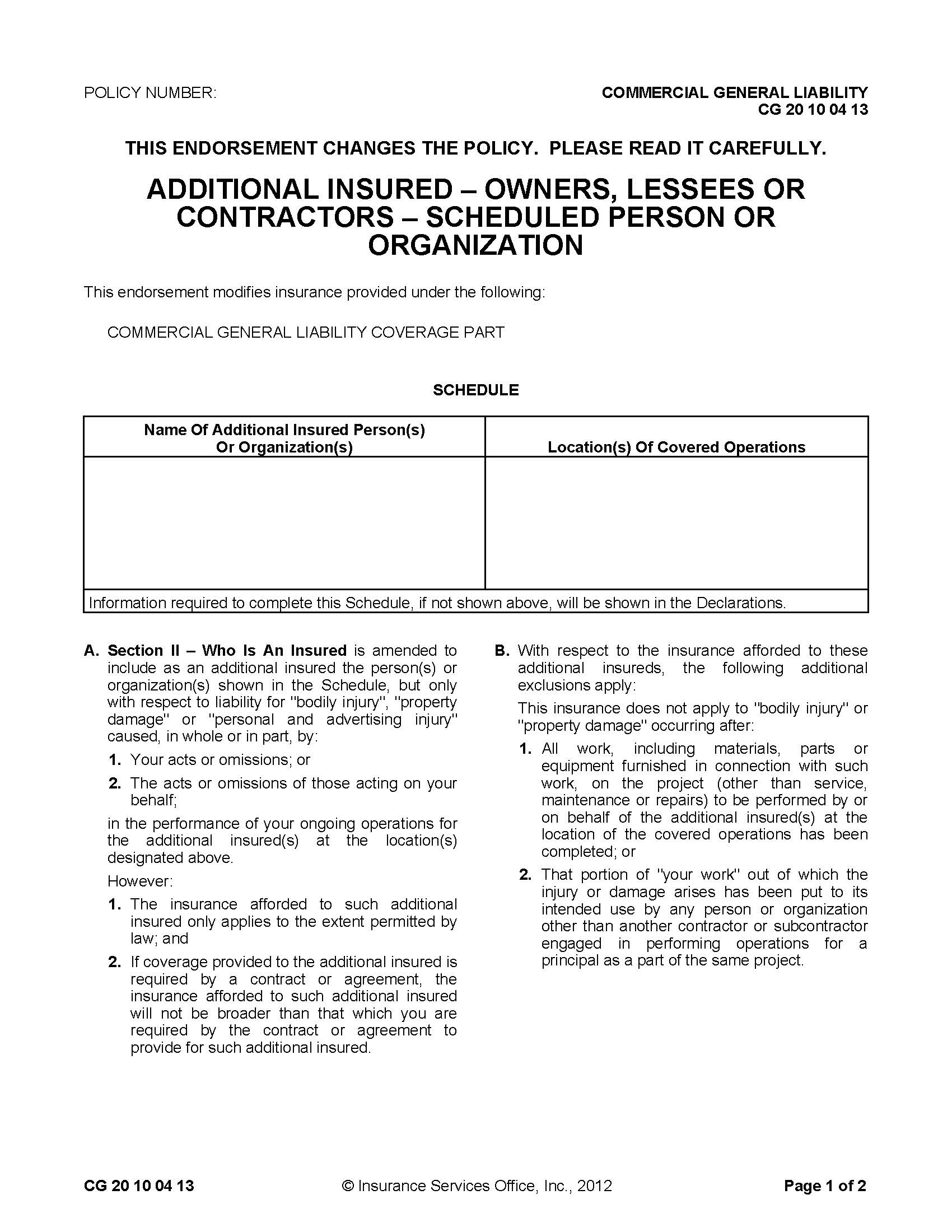
One of the most common additional insured endorsement forms in construction liability policies is “CG 20 10”, shown below:

Form CG 20 10 04 13, Additional Insured – Owners, Lessees or Contractors – Scheduled Person or Organization endorsement

As seen above, under this endorsement2, a party will qualify as an additional insured if they are listed in the schedule. Often the schedule will identify the party directly. However, the schedule may also state – “as required by contract” or “as required by written contract with the insured.” If the party satisfies being identified in the schedule, then they will qualify as additional insured and be entitled to coverage for any claim that was “caused by, in whole or in part”, the “acts or omissions” of the named insured or the acts and omissions of those working on the named insured’s behalf. All these elements are discussed below.

Key takeaway: If you are the party requiring this coverage from a subcontractor or vendor, don’t leave the choice of form to the subcontractor’s broker. Specify the actual endorsement (e.g., CG 20 10, current edition) in the subcontract and require it to cover both ongoing and completed operations — not just the active construction period. That matters most for a property owner who may face a claim well after the project is finished.

Analyzing the Schedule

The Schedule used in the additional insured endorsement usually lists one of a few options.

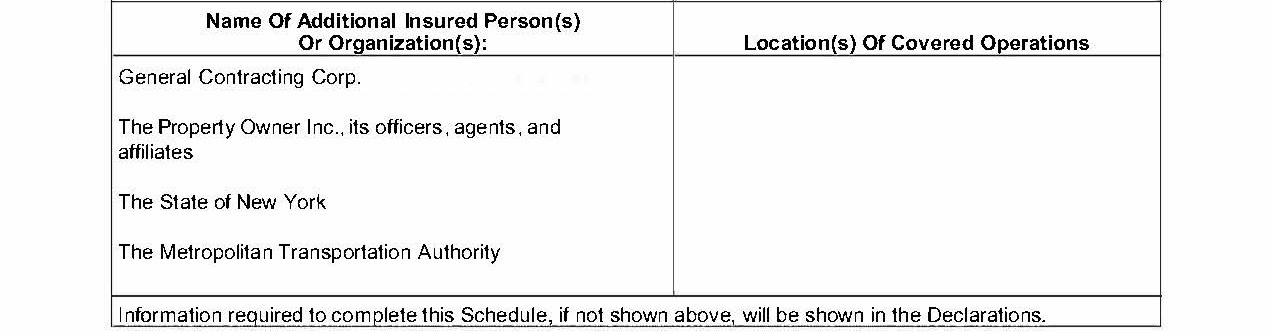
1. Scheduled Basis — the additional insured is specifically listed on the endorsement itself or on the declarations page. Four examples below:

Example endorsement schedule listing four additional insureds by name: General Contracting Corp.; The Property Owner Inc., its officers, agents, and affiliates; The State of New York; and The Metropolitan Transportation Authority

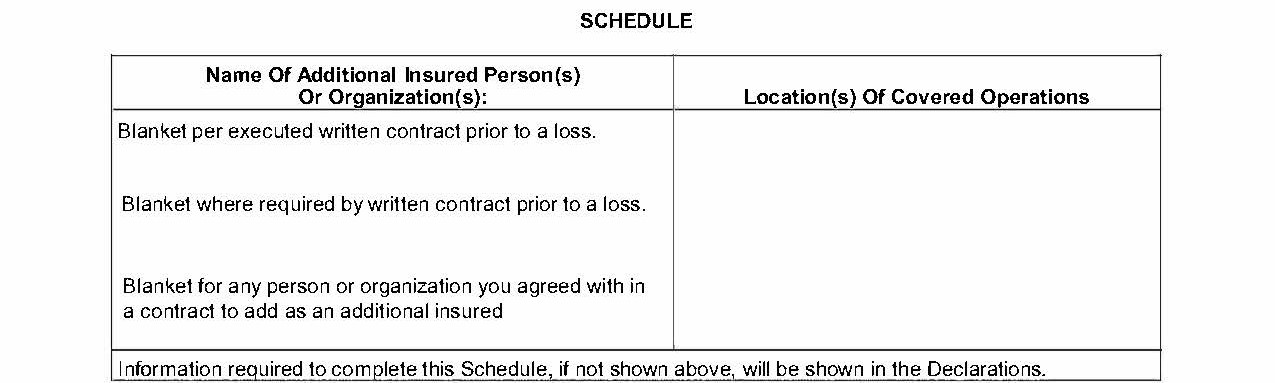
2. Automatic/Blanket Basis — additional insured status arises automatically whenever it is required by an outside agreement with the named insured. Three examples:

Example endorsement schedule with three blanket entries: per executed written contract prior to a loss; where required by written contract prior to a loss; and for any person or organization you agreed with in a contract to add as an additional insured

Does the Party Seeking Coverage Fall Within the Schedule?

If a party’s status depends on an outside agreement with the named insured (e.g., where required by contract), then the underlying agreement must satisfy the level of formality the schedule requires.

New York courts draw sharp distinctions between the terms “contract,” a “written contract,” and an “executed written contract.”3 Misjudging which tier applies is a common and avoidable reason that a tender fails.

(a) Satisfying an “agreement” or “contract”

At the base level, when the endorsement only requires there to be a “contract” or “agreement” requiring additional insured coverage, there need only be a binding contract requiring the named insured to procure additional insured coverage, in place on the date of loss. Some examples of what satisfies this term are as follows:

• A vendor’s profile on a commercial contractor directory, or a client’s vendor bulletin stating the client is typically listed as an additional insured, is not itself an agreement or contract to do so. Chipotle Mexican Grill, Inc. v. RLI Ins. Co., 158 N.Y.S.3d 201, 205 (2nd Dept. 2021).

• A proposal, estimate, or letter of intent (“LOI”) can qualify if the named insured and the other party showed intent to be bound — for example, by starting work — even if a more detailed agreement was meant to follow. Bed Bath & Beyond Inc. v. IBEX Const., LLC, 860 N.Y.S.2d 107, 109 (1st Dept. 2008); Netherlands Ins. Co. v. Endurance Am. Specialty Ins. Co., 66 N.Y.S.3d 441, 442 (1st Dept. 2018).

• If a document is merely an “agreement to agree,” there is no agreement, as these documents typically include an express reservation that neither party is bound until a more formal agreement is signed. Emigrant Bank v. UBS Real Est. Securities, Inc., 854 N.Y.S.2d 39, 41 (1st Dept. 2008).

• A certificate of insurance listing you as an additional insured is not, itself, an agreement to procure that coverage. Chipotle, 158 N.Y.S.3d at 205.

Key takeaway: If your agreement is informal or unsigned, look for conduct showing both sides treated themselves as bound — the sub mobilized on site, submitted invoices referencing the agreement, or was paid under it. That conduct can be enough on its own. If instead you are the one requiring this coverage from a sub, don’t build the program around a certificate of insurance: a COI is evidence of a policy, not proof of additional insured status, and is not itself an agreement to provide it. Always obtain and review the actual endorsement.

(b) Satisfying a “written contract”

The second tier of agreement requires that there be a “written contract”. Under New York law, a “written contract” must be in writing, but does not need to be signed. Zurich Am. Ins. Co. v. Endurance Am. Speciality Ins. Co., 43 N.Y.S.3d 40, 41 (1st Dept. 2016).

• An oral agreement or handshake will not satisfy “written contract,” even if memorialized in writing after the date of loss. Landsman Dev. Corp. v. RLI Ins. Co., 53 N.Y.S.3d 428, 430 (4th Dept. 2017).

• A certificate of insurance is not a “written contract” because it does not confer coverage. ALIB, Inc. v. A. Cas. Ins. Co., 861 N.Y.S.2d 28, 29 (1st Dept. 2008).

• A proposal or LOI (letter of intent) that qualifies as a contract at all will also satisfy “written contract.” Bed Bath & Beyond, 860 N.Y.S.2d at 108–09.

• A purchase order with no signature lines can satisfy “written” — but not “signed” or “executed.” Zurich Am. Ins. Co., 43 N.Y.S.3d at 41.

Key takeaway: Don’t assume you need a signature just because the endorsement says “written contract.” An unsigned but written proposal or purchase order can be enough at this tier — read the endorsement’s exact wording before assuming more is required.

(c) Satisfying an “executed written contract” or “signed written contract”

At this tier, executed means signed. If there is one signature line, this must be signed by the party seeking additional insured coverage. If there are two signature lines, both parties must sign. This is the tier where tenders often fail on a technicality.

• A proposal letter not signed by the construction manager seeking additional insured status did not satisfy “executed written contract.” Nicotra Group, LLC v. Am. Safety Indem. Co., 850 N.Y.S.2d 455, 457 (1st Dept. 2008); Natl. Abatement Corp. v. Natl. Union Fire Ins. Co. of Pittsburgh, PA, 824 N.Y.S.2d 230, 232 (1st Dept. 2006).

• A contract with two signature lines but only one signature is not “executed.” Cusumano v. Extell Rock, LLC, 86 A.D.3d 448, 449, 927 N.Y.S.2d 627 (1st Dept. 2011).

• A purchase order with no signature lines cannot be a “signed/executed written contract.” Zurich Am. Ins. Co., 43 N.Y.S.3d at 41.

Key takeaway: If the endorsement requires an executed or signed written contract, get the fully signed contract into the file before there’s a loss, as an unsigned proposal or a one-sided signature block will not be cured later, no matter how clear everyone’s intent was. If you are the one drafting the subcontract, build this in from the start: require the subcontract to be fully signed by both parties before the sub begins work on site, and don’t let work start on a proposal or purchase order alone if the endorsement you’re relying on requires an executed contract.

Other Contract Considerations – “Privity of Contract”

(a) Is “Privity of Contract” needed?

Example: a property owner hires a general contractor for roofing work (the “contract”). The general contractor then hires a subcontractor (the “subcontract”). The contract requires the general contractor to provide additional insured coverage to the property owner, and that the general contractor must require any subcontractor to name the owner as an additional insured. The subcontract requires the subcontractor to provide additional insured coverage for both the general contractor and the property owner. The property owner is not a party to the subcontract.

Under Form CG 20 10 (above), based on qualifying under a satisfying “written agreement”, both the general contractor and the owner are entitled to coverage under the subcontractor’s insurance. 4

Under Form CG 20 33, a stricter endorsement, only the general contractor would be entitled to coverage. The owner is not, because this endorsement requires direct privity of contract between the subcontractor and the party seeking additional insured coverage, which does not include the owner.5

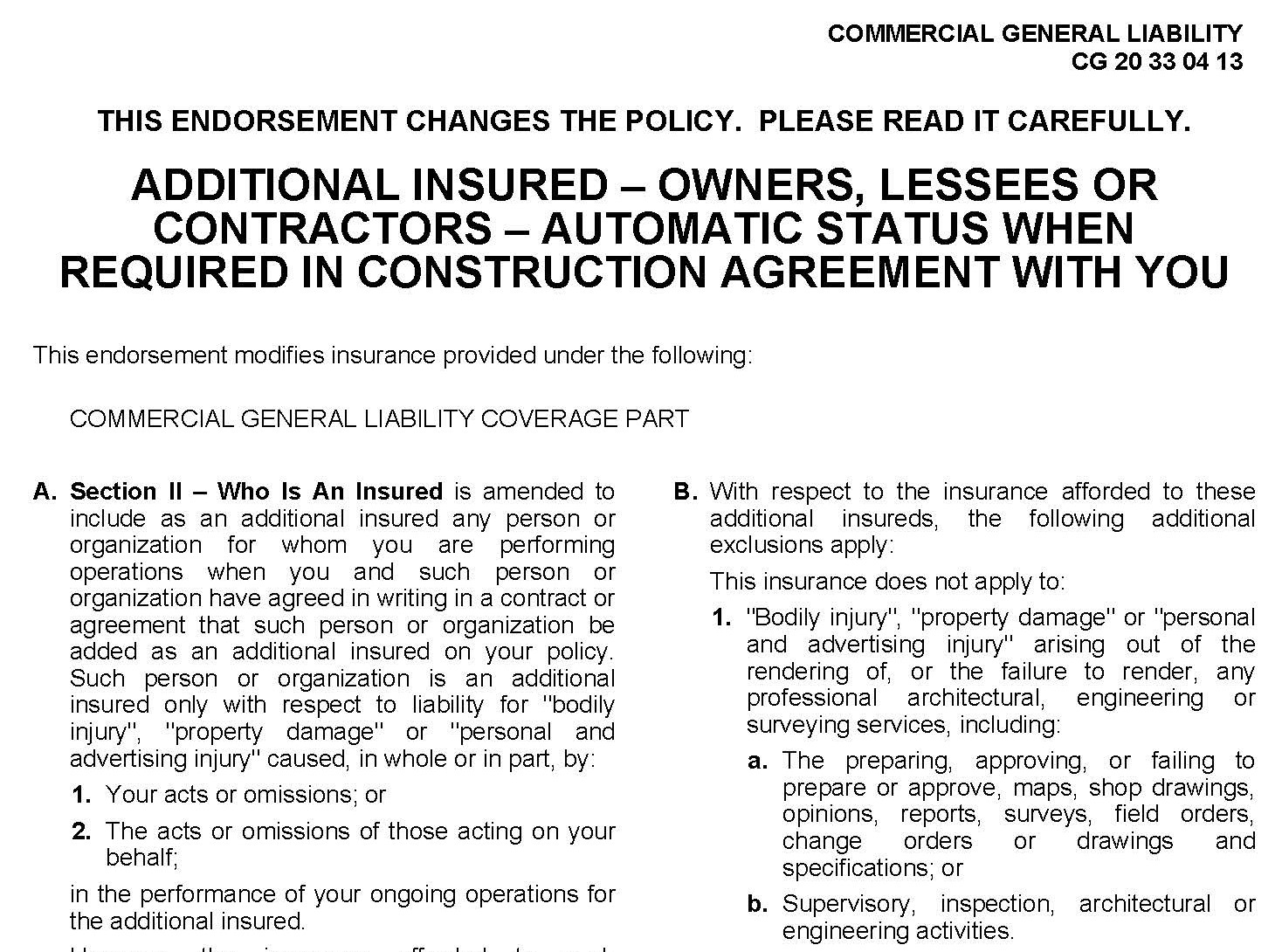
Form CG 20 33 04 13, Additional Insured – Owners, Lessees or Contractors – Automatic Status When Required in Construction Agreement With You endorsement

New York courts have held that if the policy contains a CG 20 33-type endorsement and the party seeking additional insured status has no written agreement directly with the purchaser of the insurance, there is no coverage, even if some other agreement provides that the supposed additional insured will receive it. See Gilbane Bldg. Co./TDX Constr. Corp. v St. Paul Fire & Mar. Ins. Co., 143 AD3d 146, 152, 38 NYS3d 1 [1st Dept 2016], aff’d 31 NY3d 131, 74 NYS3d 162, 97 NE3d 711 [2018]; AB Green Gansevoort, LLC v Peter Scalamandre & Sons, Inc., 102 AD3d 425, 426–427, 961 NYS2d 3 [1st Dept 2013]. This is because the endorsement states that additional insured status is only provided when there is a written contract “with you”, and “you” being the named insured. Because, in the above example, the owner does not have a written contract “with you” (i.e., the subcontractor), it does not qualify as an additional insured.

Key takeaway: If you are an owner or upper-tier contractor without a direct agreement with the sub whose policy you’re tendering to, this is the gap insurers commonly exploit. At the drafting stage, require CG 20 10 or an equivalent form that does not condition coverage on privity, or get a direct written agreement with the sub. Do not rely on a CG 20 33-type form in a multi-tier structure where you have no direct contract with the subcontractors or other downstream parties. If the loss has already happened and your contract with the sub only ties to CG 20 33, look for any direct writing, even an informal one, between you and the subcontractor before conceding the point.

Contract Issues: Does the contract require additional insured coverage?

Generally, the provision requiring the named insured to procure coverage for you in the underlying contract must be express and specifically stated. Trapani v. 10 Arial Way Associates, 755 N.Y.S.2d 396, 398 (2nd Dept. 2003). These following cases show how easily a generic insurance clause can fail to do the job:

(1) No coverage, where a contract requiring the named insured to purchase several forms of insurance for itself, without expressly requiring it to name the owner as an additional insured on its general liability coverage, does not create additional insured coverage. 140 Broadway Prop. v. Schindler Elevator Co., 901 N.Y.S.2d 292, 293 (2d Dept. 2010).

(2) No coverage, where a hold-harmless agreement with no requirement to name the owner as an additional insured does not create coverage. Hargob Realty Associates, Inc. v. Fireman’s Fund Ins. Co., 901 N.Y.S.2d 657, 659 (2nd Dept. 2010).

(3) No coverage, where an agreement to obtain liability insurance in one’s own right and separately hold the other party harmless does not create coverage. Mangano v. Am. Stock Exch., Inc., 651 N.Y.S.2d 494, 495 (1st Dept. 1996).

(4) No coverage, where a requirement of “general liability insurance” with “certificates to follow” only requires the named insured to hold its own coverage and provide proof of it — it does not create additional insured status. Trapani v. 10 Arial Way Associates, 755 N.Y.S.2d 396 (2nd Dept. 2003).

(5) No coverage, where a certificate of insurance listing the parties as additional insureds, standing alone, does not create coverage. Chipotle, 158 N.Y.S.3d at 205.

(6) No coverage, where a general clause incorporating the insurance provisions of a prime contract by reference did not create coverage here — though this can be enough if the prime contract itself has specific, on-point terms for the subcontractor. Lexington Ins. Co. v. Kiska Dev. Group LLC, 122 N.Y.S.3d 590, 592 (1st Dept. 2020).

(7) No coverage, where a blanket agreement requiring coverage for “specified owners” did not cover an owner who was not actually specified, even though it owned the property. 77 Water St., Inc. v. JTC Painting & Decorating Corp., 50 N.Y.S.3d 471, 475 (2nd Dept. 2017).

(8) No coverage, where a requirement that the named insured provide certificates of insurance from its subs listing the owner as an additional insured, without more, was not enough. Ramcharan v. Beach 20th Realty, LLC, 942 N.Y.S.2d 593, 597 (2nd Dept. 2012).

(9) No coverage, where a clause making insurance procurement a condition of an owner’s right to withhold payment — rather than an independent, express obligation — did not create coverage. Lexington Ins. Co. v. Kiska Dev. Group LLC, 122 N.Y.S.3d 590, 592 (1st Dept. 2020).

(10) Coverage found, where a contract requiring a “certificate of insurance clearly setting forth the coverage for the equipment and naming [the party] as loss payee and additional insured” was specific enough. United Rentals (N.A.), Inc. v. Conti Enterprises, Inc., 293 F. Supp. 3d 447, 456 (S.D.N.Y. 2018) (applying NY law).

Key takeaway: Every “no coverage” result above traces back to a contract clause that was vague, generic, or conditional. When you are reviewing an existing contract before a loss or drafting the next one, insist on language that expressly says the contractor/subcontractor “shall name [Owner/GC] as an additional insured” under a specific CGL form, on a primary and noncontributory basis. General language just requiring “insurance” will not suffice. A clause incorporating “the insurance requirements of the prime contract” by reference can work, but only if the referenced document actually contains specific, on-point additional insured language for that subcontractor; don’t assume a passing reference is enough.

Identity of party issues — misnamed parties on the contract, policy, or schedule

New York is generally forgiving of naming errors, and courts have held that effectively naming the insured or additional insured is enough. The policy, schedule, or contract does not need to be 100% accurate, so long as it is clearly the same party. The following cases illustrate insurers trying to deny tenders over a technical misnomer, without success:

(1) An insurer could not withhold coverage over an error listing “Court Tobacco Co.” rather than “Court Tobacco Stores, Inc.” Court Tobacco Stores, Inc. v. Great Eastern Insurance Company, 43 A.D.2d 561 (3rd Dept. 1973).

(2) A policy naming the “New York State Department of Social Welfare Commission for the Blind” was equivalent to naming the State of New York. State v. Ins. Co. of N.A., 333 N.Y.S.2d 486 (3d Dept. 1972).

(3) No meaningful difference between “Stoncor Group” and its trade name “Stonhard Corp.” Stoncor Group, Inc. v. Peerless Ins. Co., 322 F. Supp. 3d 505, 508 (S.D.N.Y. 2018).

(4) A subcontract requiring coverage for “Stellar Mechanical Services of N.Y. II” satisfied the requirement for “Stellar Mech. Services of New York, Inc.” Stellar Mech. Services of New York, Inc. v. Merchants Ins. of New Hampshire, 903 N.Y.S.2d 471, 475 (2d Dept. 2010).

(5) An insurer could not withhold coverage over a misidentified named insured where the intent to cover the project’s risk was clear. N.Y. Cas. Ins. Co. v. Shaker Pine, 262 A.D.2d 735, 736 (3rd Dept. 1999).

(6) An insurer’s obligation to cover a mortgage holder’s risk applied even though the mortgage holder was misidentified in the contract. Cheperuk v. Liberty Mutual Fire Insurance Company, 263 A.D.2d 748 (3d Dept. 1999).

(7) Even though only the former landlord was listed as the additional insured, the current landlord was entitled to coverage where the named insured had agreed to insure the landlord and the policy expressly covered the landlord’s risk. 137 Broadway Associates, LLC v. 602 W. 137th Deli Corp., 975 N.Y.S.2d 710 (N.Y. Sup. Ct. 2013).

Key takeaway: If you are the one drafting the subcontract, get entity names right — but don’t panic over minor variations that do slip through. New York courts will look past immaterial misnomers so long as the intended party is clear, as the cases above show.

II. The Duty to Defend

Once you have established additional insured status, the analysis turns to whether the underlying claim is covered, i.e., whether the insurer has an obligation to provide coverage for the additional insured.

There are two distinct duties of an insurance company with respect to providing additional insured coverage: (1) the duty to defend, and (2) the duty to indemnify. The former is an insurance company’s duty to hire attorneys to defend the additional insured in the lawsuit, while the latter is an insurance company’s duty to actually pay for the claimed injury, should the claimant be successful in the lawsuit.

It is well settled under New York law that an insurance company’s duty to defend is “exceedingly broad.” Auto. Ins. Co. of Hartford v. Cook, 7 N.Y.3d 131, 137 (2006). The duty to defend is broader than an insurer’s duty to indemnify. Id.

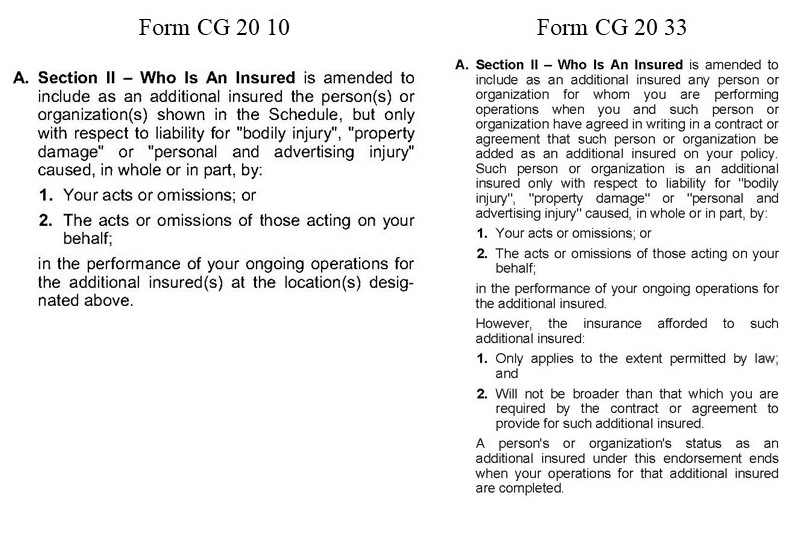
The scope of an insurer’s duty to provide additional insured coverage depends on the endorsement’s language:

Side-by-side comparison of Section A of Form CG 20 10 and Form CG 20 33, each covering liability caused, in whole or in part, by the named insured

These above common forms provide that there is additional insured coverage for liability “caused, in whole or in part,” by the named insured. In Burlington Ins. Co. v NYC Tr. Auth., the Court of Appeals held that “caused, in whole or in part” means “proximate cause”. 57 N.Y.S.3d 85 (2017)6.

Critically, the Burlington standard is applicable to an insurer’s duty to indemnify its insureds, not the duty to defend. This is because the duty to defend an insured is a much lower bar, and so it is triggered by a claim having only a reasonable possibility of meeting the Burlington standard.7

Therefore, an additional insured does not need to prove the named insured was an actual proximate cause of the claim/injury to be entitled to a defense, as that determination usually waits for a court or jury. Only the possibility of that finding is required to trigger a duty to defend.8 Once triggered, an insurer must defend the additional insured no matter how groundless, false or baseless the suit may be.9

The possibility of coverage, and therefore, the duty to defend, can be triggered in multiple ways in a claim, including where the allegations of a complaint directly “suggest … a reasonable possibility of coverage”; extrinsic evidence outside the complaint suggests the possibility of coverage; or even a third-party complaint – filed by the additional insured, can trigger an insurer’s duty to defend.10

The Burlington standard is commonly weaponized by insurers to avoid providing any coverage to its additional insureds, including providing a defense. This is because once an insurer steps in to defend its additional insured, it cannot withdraw from that defense without a court order11. A common excuse found in tender rejection letters is that the additional insured is not entitled to coverage because there is no proof that the claim/injury was caused by, in whole or in part, the acts or omissions of the named insured. This is a transparent misuse of the Burlington standard and should be challenged by any party seeking additional insured coverage.

Therefore, when tendering to an insurance company, or analyzing an insurer’s response to the tender, review and provide every available fact that would trigger the duty to defend, including:

(a) the pleadings (the named insured need not even be a party — for example, where the plaintiff is the named insured’s employee);

(b) discovery materials (deposition testimony, bills of particulars, etc.);

(c) third-party complaints — including one filed by the party seeking additional insured coverage itself; and

(d) known facts outside the four corners of the complaint, which can help trigger the duty to defend (e.g., a contract showing that the named insured was working on site at the time of the injury); and

(e) importantly, an insurer cannot rely on outside information to escape a defense obligation that the allegations otherwise trigger. Fitzpatrick v. Am. Honda Motor Co., Inc., 575 N.E.2d 90 (1991)

Key takeaway: If an insurer disclaims based on the complaint alone, check whether discovery, a third-party complaint, or facts you already know about the loss would independently support the reasonable-possibility standard and put the insurer on notice of those facts in writing.

III. The Duty to Indemnify

The partner of the duty to defend is the duty to indemnify. Indemnification of a claim means that the insurer will have to pay for the liability of its insureds, if the claimant is successful in the lawsuit. As discussed above, if the additional insured form uses the language “caused, in whole or in part”, under the Burlington standard, this means that the duty to indemnify will trigger only if the named insured was at least a proximate cause of the liability. This can be as little as 1% of the proximate cause. However, because proximate cause is a legal determination, it ultimately requires a judicial finding.

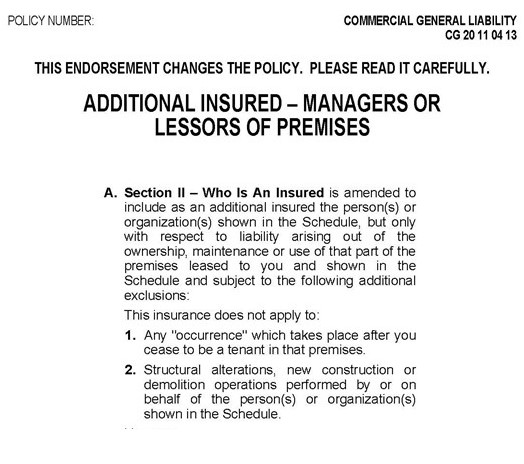
There are some policy forms that use a different trigger than the Burlington language. For example, the term “arising out of”, as seen in the below form, is a broader, alternative trigger. “Arising out of” means “originating from, incident to, or having connection with.” This broader term requires only some causal relationship between the injury and the insured risk to trigger an insurer’s duties12.

Form CG 20 11 04 13, Additional Insured – Managers or Lessors of Premises endorsement, using arising out of language

Under the “arising out of” language, the focus of the indemnification trigger is on the general nature of the operation during which the injury occurred, and you do not need to wait for a judicial determination of liability to trigger indemnity under this standard13.

However, even this broader language will not trigger in every circumstance. Two examples where courts found no “arising out of” connection are as follows:

• A subcontractor had finished installing stairs and left the site; the general contractor conceded the staircase was merely the situs of the accident. Worth Const. Co., Inc. v. Admiral Ins. Co., 888 N.E.2d 1043 (2008).

• A bodily injury occurring outside the leased premises did not arise out of the named insured’s performance operations at the premises. Christ the King Regl. High Sch. v. Zurich Ins. Co. of N.A., 937 N.Y.S.2d 290, 294 (2nd Dept. 2012).

IV. Conditions and Exclusions

Even when a claim otherwise triggers additional insured coverage, certain policy terms, conditions, or exclusions can stop coverage for an event. Some of these conditions, terms, or exclusions may be imposed on the named insured, and some on the additional insured.

Conditions

Conditions in insurance policies can be express or implied.14 Express conditions are those agreed to and imposed by the parties themselves. In an insurance context, express conditions “must be literally complied with before a party to the contract may recover.” If a condition is a “condition precedent”, that condition must occur before an insurer has any obligation to perform its duties. More so, if there is a “condition precedent”, an insurer only needs to show that the condition was not met to avoid coverage, it does not need to show that it was prejudiced by the insured’s failure to meet that condition. A condition precedent usually but not always states that it is a condition precedent.

A common policy condition is that an insured must notify the insurer as soon as possible after it discovers or is notified of a claim, or that an insured must cooperate with the insurer. An example of a condition precedent is where a named insured must require its subcontractors to name it as an additional insured in their policies (and that the policy states that such requirement is a condition precedent).

That said, a named insured’s breach of a policy condition — including a condition precedent, such as late notice or lack of cooperation — is not grounds for disclaiming coverage to an additional insured.15 This means that if the named insured breached a policy condition by, for example, failing to notify the insurer of a claim until very late, an additional insured would still be entitled to coverage under that policy, even though the named insured was excluded from coverage for its failure to satisfy a condition.

Therefore, an insurer cannot point to the named insured’s own missteps in handling the claim to deny your separate coverage. (A breach of a condition by the additional insured itself is a different matter and can be grounds for denial.)

However, some acts of the named insured may still invalidate coverage for the additional insured. Usually, these types of breaches invalidate the entire policy. An example of this would be if the named insured had a material misrepresentation in the application of the policy. If the insurer can prove this, and that they were prejudiced by that misrepresentation, they may be allowed to void the entire policy, ab initio, or stated otherwise, make it as if the policy was never issued in the first place. So there would not be any additional insured coverage under the policy because there was no policy in the first place. That is because “additional insureds, by definition, must exist in addition to something; namely, the named insureds in a valid existing policy.”16

Exclusions

An exclusion is a policy term that seeks to exclude coverage for an otherwise covered event. These differ from conditions in that conditions can apply before coverage may be applied, while exclusions only apply after coverage for a claim is triggered.

Whether an exclusion applies to an additional insured depends entirely on the policy’s wording, usually, whether the policy uses the language “the insured” or “any insured.”

• “The insured” limits a condition or exclusion to the particular insured it describes, or to the particular insured seeking coverage;

• “Any insured” (or “an insured”) binds all insureds to the consequences of any one insured’s act;

• The “named insured” is limited only to the named insured on the policy declarations.

These terms are commonly found in exclusions for an employee injury. For example, if an exclusion states that it applies for injury to an employee of the insured, the exclusion only bars coverage for the specific insured who actually employed the plaintiff, but it will not apply for an additional insured who was not the employer. If the same exclusion is written for an employee of “any insured”, then the exclusion bars coverage for all insureds, named and additional alike, if any of them employed the injured person.17 Therefore, some exclusions that would apply to one insured, may not apply to another.

Key takeaway: Always read the exact article of the exclusion the insurer is relying on. If it says “the insured” and the excluded conduct or relationship belongs only to the named insured, that exclusion should not reach you.

V. Insurance Law § 3420(d) & Denial Letters

Insurance Law §3420(d) is a strong tool for any insured. This statute applies to any liability policy that provides coverage with respect to a claim arising out of the death or bodily injury of any person.18 This provision outlines the requirements of an insurer’s response to a claim (arising out of bodily injury), such as a tender response, denial letter, reservation of rights, etc. Critically, “failure to comply with section 3420(d) precludes denial of coverage based on a policy exclusion.”19 So an insurer’s procedural defect under this provision can invalidate its entire position and waive its right to rely on policy exclusions.

• The basic requirement of Section 3420(d)(2) is that an insurer shall give written notice as soon as is reasonably possible of any denial letter to the insured and the injured person or any other claimant.

The determination of what is “as soon as reasonably possible” is generally fact specific, as not all the grounds for an exclusion will be available at the outset of a claim. Timeliness of insurer’s disclaimer of liability is measured from time when insurer first learns of grounds for disclaimer or denial of coverage20.

That said, “where the sole ground upon which the disclaimer is based is obvious from the face of the notice of claim and accompanying complaint, a delay of even 30 days has been held to be unreasonable.”21 If the grounds for a disclaimer are obvious, an insurer will have to provide an acceptable excuse for its delay, or else it will waive its right to deny the claim22.

An example of this is where an insurer denies coverage to a named insured, and months later, an additional insured tenders for coverage. If the insurer denies the tender on the same grounds as it denied the named insured’s claim, it will have no excuse for a late denial letter (because the grounds for its disclaimer were already obvious by virtue of its disclaimer to the named insured).

• Section 3420(d)(2) requires that a disclaimer letter include, “with a high degree of specificity,” the ground or grounds on which the disclaimer is predicated.23 If a disclaimer letter does not specify a certain ground for its denial, the insurer will waive its right to rely on that ground for excluding coverage.24

A disclaimer letter must “identify the applicable policy exclusion and set forth the factual basis for the insurer’s position that the claim fell within a policy exclusion, with sufficient specificity to satisfy the statutory mandate and purpose.”25 That said, a small misquotation or a partial omission of the policy language of an exclusion does not invalidate it automatically, so long as the letter is otherwise sufficiently specific on the exclusion’s application.26 If an insurer denies coverage on one ground, then it will have waived all other grounds for denial (that were available at that time).

• Section 3420(d)(2) applies to additional insureds.27 Under New York law, additional insureds are entitled to the same protections as a named insured, including timely notice of disclaimer.28

• Section 3420(d)(2) requires the insurer to send disclaimer notice directly to the additional insured (or its counsel), and failure to do so precludes the insurer from disclaiming based on an exclusion.29 A letter sent only to the additional insured’s own insurer does not satisfy § 3420(d)(2).30

• A copy of the disclaimer sent to the named insured can satisfy § 3420 — but only if that letter specifically addresses coverage for the additional insured (e.g., “therefore, there is no coverage available under the Policy for this claim for any party, including any additional insureds”). If a disclaimer only addresses the named insured’s own coverage, the disclaimer letter will not apply to the additional insured.

• A reservation of rights letter does not constitute compliance with the requirements of section 3420(d).31

• 3420(d) applies whether the policy of insurance is primary or excess.32

Any failure on any of these points is an independent basis to challenge the denial, separate from the merits of coverage.

When tendering a claim on your behalf, confirm the package includes:

• Identification of who is tendering and on whose behalf;

• The named insured and the specific policy being tendered to (if available);

• The claim documentation (complaint, notice of loss, etc.);

• The contract or agreement connecting you to the named insured, matched against the endorsement’s exact requirement (contract vs. written contract vs. executed written contract, and scheduled vs. blanket basis); and

• A letter invoking the triggering language for the duty to defend with supporting facts (from the pleadings, discovery, or otherwise).

If you are drafting or negotiating a contract with a contractor, subcontractor, or any downstream party, build these protections into the contract before the work or contract begins:

• Express, specific language that the subcontractor “shall name [Owner/GC] as an additional insured”, on a primary and noncontributory basis, with specific limits. Make sure not to only use generic language requiring only that the sub “maintain insurance”;

• A fully executed contract, signed by both parties before work begins;

• State the specific additional insured endorsement form (e.g., CG 20 10), covering both ongoing and completed operations; and

• Ensure that additional downstream entities do not require direct privity-of-contract, such as in a CG 20 33-type endorsement.

* * *

Aboulafia Law Firm LLC works exclusively on behalf of policyholders and has decades of experience fighting insurance companies. Whether you are dealing with a residential or commercial property claim, we are ready to help you. If you are seeking to obtain additional insured coverage or are dealing with a tender, don’t navigate the complex claims process alone. For assistance on your insurance claim, please contact us.

The opinions expressed are those of the author(s) and do not necessarily reflect the views of the firm, its clients, or any of its or their respective affiliates. This article is for general information purposes and is not intended to be and should not be taken as legal advice.

Aaron Jacob is a senior associate at Aboulafia Law Firm LLC. Mr. Jacob is a skilled litigation and coverage attorney and has extensive experience representing commercial and private clients involved in property damage and insurance coverage claims in complex state and federal court matters.

Mr. Jacob focuses his practice on advocating for policyholders in high-exposure property damage cases, insurance recovery claims, coverage disputes, construction-related claims, declaratory judgments, first & third-party claims, business interruption losses, indemnification, additional insured coverage, broker negligence, risk transfer, contractor/subcontractor liability, bad faith claims, contribution claims, breach of contract disputes, and general liability defense, as well as in litigating insurance coverage issues under several policy lines including homeowners, commercial liability, excess/umbrella, businessowners, cargo, freighting, and commercial auto policies.


Footnotes

1. Tribeca Broadway Associates, LLC v. Mt. Vernon Fire Ins. Co., 774 N.Y.S.2d 11, 13 (1st Dept. 2004). ↩

2. This specific endorsement form is usually the most lenient and advantageous for additional insureds. ↩

3. Chipotle Mexican Grill, Inc. v. RLI Ins. Co., 158 N.Y.S.3d 201, 205 (2nd Dept. 2021) (“agreement” or “contract”); Zurich Am. Ins. Co. v. Endurance Am. Speciality Ins. Co., 43 N.Y.S.3d 40, 41 (1st Dept. 2016) (“written contract”); Nicotra Group, LLC v. Am. Safety Indem. Co., 850 N.Y.S.2d 455, 457 (1st Dept. 2008) (“executed written contract”). ↩

4. Direct privity of contract can also be required under Form CG 20 10, depending on the language used in the schedule. E.g., if the schedule purports to only provide coverage for people that “you agreed with” in a contract, some courts may interpret that language as requiring direct privity of contract. Under this language, the analysis is comparable to CG 20 33. ↩

5. See, above. ↩

6. An alternative trigger to “caused, in whole or in part,” is “arising out of”, discussed later. ↩

7. See Live Nation Mktg., Inc. v. Greenwich Ins. Co., 135 N.Y.S.3d 87, 89 (1st Dept. 2020); Indian Harbor Ins. Co. v. Alma Tower, LLC, 87 N.Y.S.3d 9, 10 (N.Y. App. Div. 1st Dept. 2018) (“because there is a reasonable possibility that [the named insured] proximately caused the injury…”). ↩

8. Citizens Ins. Co. of Am. v. Am. Ins. Co., 130 N.Y.S.3d 289, 290 (1st Dept. 2020) ↩

9. Automobile Ins. Co. of Hartford v. Cook, 850 N.E.2d 1152, 1155 (2006). ↩

10. Id.; see also, Wesco Ins. Co. v. Hellas Glass Works Corp., 2020 NY Slip Op 06975, ¶ 1, 188 A.D.3d 621, 621, 132 N.Y.S.3d 758, 758 (App. Div. 1st Dept. 2020); One Reason Rd., LLC v. Seneca Ins. Co., Inc., 83 N.Y.S.3d 235, 238 (2nd Dept. 2018); All State Int. Demolition Inc. v. Scottsdale Ins. Co., 92 N.Y.S.3d 256, 257 (1st Dept. 2019); Indian Harbor Ins. Co. v. Alma Tower, LLC, 165 AD3d 549, 549 (1st Dept 2018); Greater New York Mut. Ins. Co. v. State Natl. Ins. Co., Inc., 120 N.Y.S.3d 578 (N.Y. Sup. Ct. 2019); Travelers Prop. Cas. Co. of Am. v. Harleysville Ins. Co. of N.Y., 128 N.Y.S.3d 154 (Sup. Ct. 2020) (rejecting an insurer’s argument that a third-party complaint cannot be relied upon to establish a duty to defend). ↩

11. Seye v. Sibbio, 821 N.Y.S.2d 473 (2d Dept. 2006) ↩

12. Regal Constr. Corp. v National Union Fire Ins. Co. of Pittsburgh, PA, 15 NY3d 34, 38, 930 N.E.2d 259, 904 N.Y.S.2d 338 (2010) ↩

13. Hunter Roberts Const. Group., LLC v. Arch Ins. Co., 75 AD3d 404, 408 (1st Dept. 2010) ↩

14. Oppenheimer & Co. v. Oppenheim, Appel, Dixon & Co., 636 N.Y.S.2d 734, 660 N.E.2d 415, 418 (1995); Seaport Park Condo. v. Greater New York Mut. Ins. Co., 828 N.Y.S.2d 381, 384 (1st Dept. 2007). ↩

15. 233 E. 17th St., LLC v. L.G.B. Dev., Inc., 913 N.Y.S.2d 110, 112 (2nd Dept. 2010). ↩

16. Admiral Ins. Co. v. Joy Contractors, Inc., 19 N.Y.3d 448, 461 (2012) ↩

17. Moleon v. Kreisler Borg Florman Gen. Const. Co., Inc., 758 N.Y.S.2d 621, 624 (1st Dept. 2003); Sixty Sutton Corp. v. Illinois Union Ins. Co., 825 N.Y.S.2d 46, 49 (1st Dept. 2006); Soho Plaza Corp. v. Birnbaum, 969 N.Y.S.2d 96, 100 (2d Dept. 2013). ↩

18. This statute does not apply, however, to claims, for example, for property damage or business interruption losses. ↩

19. Matter of Worcester Ins. Co. v Bettenhauser, 95 NY2d 185, 188, 734 N.E.2d 745, 712 N.Y.S.2d 433 (2000) ↩

20. Allcity Ins. Co. v Jimenez, 78 N.Y.2d 1054, 576 N.Y.S.2d 87, 581 N.E.2d 1342, (1991) ↩

21. Gagosian Gallery, Inc. v. Eurostruct, Inc., 814 N.Y.S.2d 890 (N.Y. Sup. Ct. 2005) citing West 16th Street Tenants Corp. v. Pub. Service Mut. Ins. Co., 736 N.Y.S.2d 34 (1st Dept. 2002). ↩

22. Id., see also AIU Ins. Co. v. Veras, 942 N.Y.S.2d 532, 533 (1st Dep’t 2012); Sirius Am. Ins. Co. v. Vigo Const. Com., 852 N.Y.S.2d 176, 178 (2d Dep’t 2008) (finding 34-day delay unreasonable as a matter of law where no explanation was provided). ↩

23. Gen. Accident Ins. Grp. v. Cirucci, 46 N.Y.2d 862, 414 N.Y.S.2d 512, 387 N.E.2d 223, 225 (1979). ↩

24. Id., see also Zappone v. Home Ins. Co., 55 N.Y.2d 131, 135 (1982) ↩

25. Adams v. Perry’s Place, 168 A.D.2d 932, 564 N.Y.S.2d 1019, 1019 (1990). ↩

26. Id. ↩

27. See Sierra v 4401 Sunset Park, LLC, 957 N.Y.S.2d 219 (2d Dept 2012), affd 25 N.E.3d 921 (2014); Matter of Worcester Ins. Co. v Bettenhauser, 95 NY2d 185, 188, 734 N.E.2d 745, 712 N.Y.S.2d 433 (2000). ↩

28. Id. ↩

29. Sierra v. 4401 Sunset Park, LLC, 24 N.Y.3d 514, 2 N.Y.S.3d 8 (2014). ↩

30. Id. (“The obligation imposed by the Insurance Law is to give timely notice to the mutual insureds … not to … another insurer”). ↩

31. Zappone v. Home Ins. Co., 55 N.Y.2d 131, 135 (1982). ↩

32. Id. ↩