
September 2026, by Aaron Jacob, Esq.
Risk protection and liability transfer are of critical importance to any property owner, general contractor, lessor, licensor, or other businesses that contract with subcontractors, vendors, lessees, licensees, or other downstream entities. Most contracts and subcontracts already require the downstream party to carry insurance and name the upstream party as an “additional insured” on their insurance policy as well as contain indemnification rights. Often, you will also get a certificate of insurance from that party, purportedly showing that they procured the required coverage.
However, if a claim ever gets filed, many parties suddenly find themselves without the contracted-for protection and find that the certificate of insurance is not worth the paper it is written on. Then, the upstream party has to use its own insurance to defend them against a claim, or if they are uninsured, pay out of pocket for counsel. This is at least partly because insurers routinely look for reasons to deny additional insured requests and find opportunities to deny tenders or indemnification demands due to a handful of technicalities in contracts or policies that come up repeatedly.
Drafting the contract carefully and securing the correct policy initially alleviates many of the issues but also understanding how you can trigger additional insured coverage and/or indemnification rights, or challenge an insurer’s response after the fact, can be incredibly helpful.
An analysis of common additional insured endorsements under New York law is below, including what a party needs to prove to qualify as an additional insured, what to include in your tender, and what to require up front when drafting the contract so a future tender doesn’t run into an avoidable problem.
What Are Additional Insureds?
Additional insureds are parties who are entitled to insurance coverage under someone else’s (the “named insured”) policy of insurance. A classic example is an owner of a property requiring that they are named as an additional insured on a policy of insurance held by a contractor who is performing construction work at the owner’s property. This way, if someone is injured during construction as a result of the contractor’s work, and the injured party sues the owner, the owner can look to the contractor’s insurer for insurance coverage to defend the claims.
Under New York law, additional insureds are entitled to the same type of coverage under the policy as the named insured. Pecker Iron Works of N. Am., Inc. v. Travelers Ins. Co., 99 N.Y.2d 391 (2003). Similarly, the standard for determining whether an additional insured is entitled to coverage for a claim is the same standard as determining whether a named insured is entitled to coverage. Id., see also BP Air Conditioning Corp. v. One Beacon Ins. Grp., 8 N.Y.3d 708, 715 (2007).
However, there are many types of policy forms and endorsements that purport to provide additional insured coverage, but they are not all equal in how easy it is to qualify for that coverage. If a claim is filed against you, there are three things needed before you can enjoy full protection as an additional insured.
(1) that you qualify as an additional insured;
(2) that the duty to defend has been triggered; and
(3) that, if the claimant is ultimately successful on their claims, the duty to indemnify has been triggered.
In New York, there are also laws that protect insureds from certain acts by an insurance company, including a late response (Ins. Law 3420(d)), discussed later.
I. The Complete Tender Package
Proving you qualify as an additional insured
The burden is on the party seeking additional insured coverage to establish entitlement in the first instance.1 Because that burden falls on you, the tender should be drafted so that the insurer has no room to claim the proof was insufficient. A complete tender package should include:
(a) the identity of who is sending the tender (and on whose behalf) — you, your attorney, or your own insurer;
(b) the identity of the named insured and the policy under which additional insured coverage is sought;
(c) information about the underlying claim, with supporting documents — e.g., the summons and complaint, or a claimant’s notice of loss; and
(d) documentation connecting the named insured to the claim and to your right to additional insured status — typically the contract between you and the named insured requiring the additional insured endorsement.
Key takeaway: Before you send the tender, compare the underlying contract against the specific requirements of the additional insured endorsement itself (discussed below). A mismatch between the two is a very common reason insurers reject a tender — catching it before you send the package lets you gather better proof instead of receiving a denial. And if you are instead the party requiring this coverage from a subcontractor or vendor, this is also exactly what to fix at the drafting stage: keep the fully executed contract and the actual additional insured endorsement — not just a certificate of insurance — in the project file for the life of the project plus the statute of limitations, so this step is never the reason a future tender fails.
The Additional Insured Endorsement
The two most common issues in qualifying for additional insured coverage arise from either the language of the contract, or the language of the additional insured endorsement in the policy. Identifying which additional insured endorsement is actually included in the named insured’s policy and what you must show to qualify as an additional insured depends entirely on its wording.
One of the most common additional insured endorsement forms in construction liability policies is “CG 20 10”, shown below:
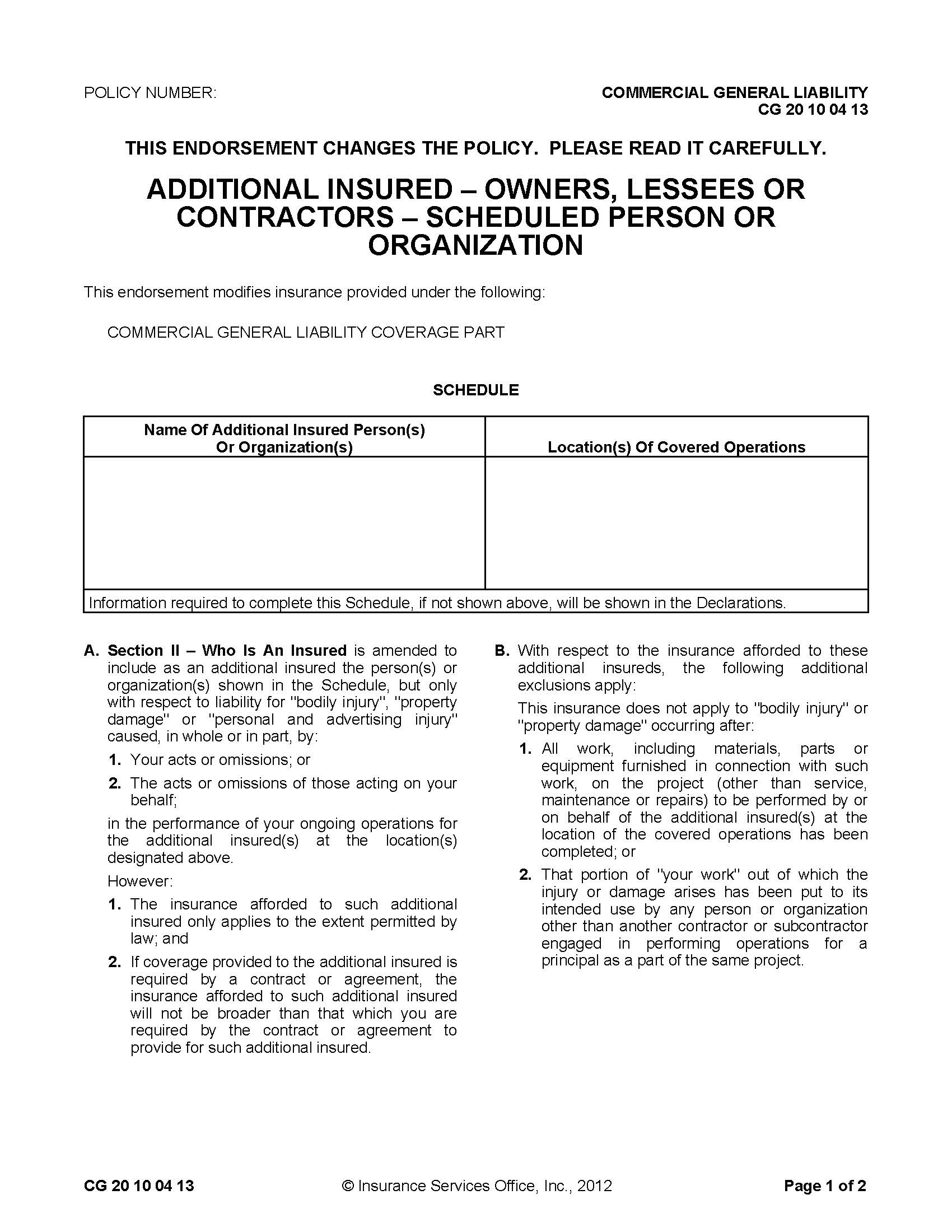
As seen above, under this endorsement2, a party will qualify as an additional insured if they are listed in the schedule. Often the schedule will identify the party directly. However, the schedule may also state – “as required by contract” or “as required by written contract with the insured.” If the party satisfies being identified in the schedule, then they will qualify as additional insured and be entitled to coverage for any claim that was “caused by, in whole or in part”, the “acts or omissions” of the named insured or the acts and omissions of those working on the named insured’s behalf. All these elements are discussed below.
Key takeaway: If you are the party requiring this coverage from a subcontractor or vendor, don’t leave the choice of form to the subcontractor’s broker. Specify the actual endorsement (e.g., CG 20 10, current edition) in the subcontract and require it to cover both ongoing and completed operations — not just the active construction period. That matters most for a property owner who may face a claim well after the project is finished.
Analyzing the Schedule
The Schedule used in the additional insured endorsement usually lists one of a few options.
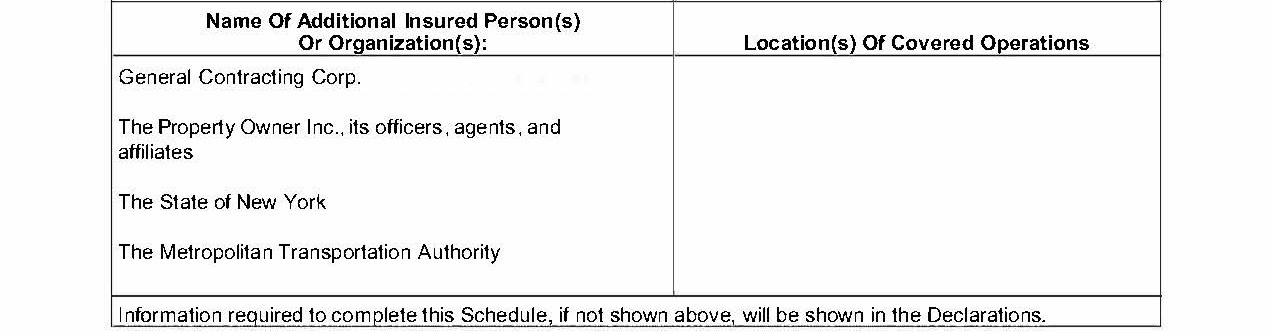
1. Scheduled Basis — the additional insured is specifically listed on the endorsement itself or on the declarations page. Four examples below:
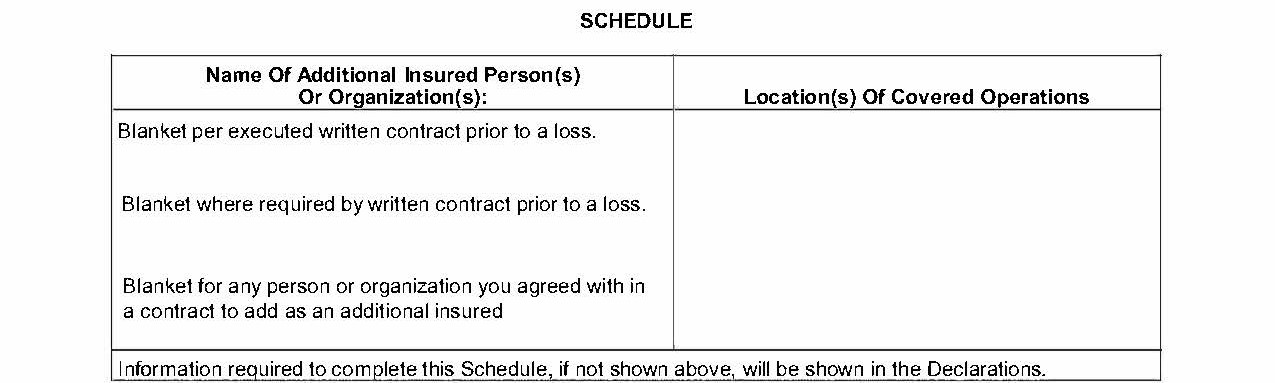
2. Automatic/Blanket Basis — additional insured status arises automatically whenever it is required by an outside agreement with the named insured. Three examples:
Does the Party Seeking Coverage Fall Within the Schedule?
If a party’s status depends on an outside agreement with the named insured (e.g., where required by contract), then the underlying agreement must satisfy the level of formality the schedule requires.
New York courts draw sharp distinctions between the terms “contract,” a “written contract,” and an “executed written contract.”3 Misjudging which tier applies is a common and avoidable reason that a tender fails.
(a) Satisfying an “agreement” or “contract”
At the base level, when the endorsement only requires there to be a “contract” or “agreement” requiring additional insured coverage, there need only be a binding contract requiring the named insured to procure additional insured coverage, in place on the date of loss. Some examples of what satisfies this term are as follows:
• A vendor’s profile on a commercial contractor directory, or a client’s vendor bulletin stating the client is typically listed as an additional insured, is not itself an agreement or contract to do so. Chipotle Mexican Grill, Inc. v. RLI Ins. Co., 158 N.Y.S.3d 201, 205 (2nd Dept. 2021).
• A proposal, estimate, or letter of intent (“LOI”) can qualify if the named insured and the other party showed intent to be bound — for example, by starting work — even if a more detailed agreement was meant to follow. Bed Bath & Beyond Inc. v. IBEX Const., LLC, 860 N.Y.S.2d 107, 109 (1st Dept. 2008); Netherlands Ins. Co. v. Endurance Am. Specialty Ins. Co., 66 N.Y.S.3d 441, 442 (1st Dept. 2018).
• If a document is merely an “agreement to agree,” there is no agreement, as these documents typically include an express reservation that neither party is bound until a more formal agreement is signed. Emigrant Bank v. UBS Real Est. Securities, Inc., 854 N.Y.S.2d 39, 41 (1st Dept. 2008).
• A certificate of insurance listing you as an additional insured is not, itself, an agreement to procure that coverage. Chipotle, 158 N.Y.S.3d at 205.
Key takeaway: If your agreement is informal or unsigned, look for conduct showing both sides treated themselves as bound — the sub mobilized on site, submitted invoices referencing the agreement, or was paid under it. That conduct can be enough on its own. If instead you are the one requiring this coverage from a sub, don’t build the program around a certificate of insurance: a COI is evidence of a policy, not proof of additional insured status, and is not itself an agreement to provide it. Always obtain and review the actual endorsement.
(b) Satisfying a “written contract”
The second tier of agreement requires that there be a “written contract”. Under New York law, a “written contract” must be in writing, but does not need to be signed. Zurich Am. Ins. Co. v. Endurance Am. Speciality Ins. Co., 43 N.Y.S.3d 40, 41 (1st Dept. 2016).
• An oral agreement or handshake will not satisfy “written contract,” even if memorialized in writing after the date of loss. Landsman Dev. Corp. v. RLI Ins. Co., 53 N.Y.S.3d 428, 430 (4th Dept. 2017).
• A certificate of insurance is not a “written contract” because it does not confer coverage. ALIB, Inc. v. A. Cas. Ins. Co., 861 N.Y.S.2d 28, 29 (1st Dept. 2008).
• A proposal or LOI (letter of intent) that qualifies as a contract at all will also satisfy “written contract.” Bed Bath & Beyond, 860 N.Y.S.2d at 108–09.
• A purchase order with no signature lines can satisfy “written” — but not “signed” or “executed.” Zurich Am. Ins. Co., 43 N.Y.S.3d at 41.
Key takeaway: Don’t assume you need a signature just because the endorsement says “written contract.” An unsigned but written proposal or purchase order can be enough at this tier — read the endorsement’s exact wording before assuming more is required.
(c) Satisfying an “executed written contract” or “signed written contract”
At this tier, executed means signed. If there is one signature line, this must be signed by the party seeking additional insured coverage. If there are two signature lines, both parties must sign. This is the tier where tenders often fail on a technicality.
• A proposal letter not signed by the construction manager seeking additional insured status did not satisfy “executed written contract.” Nicotra Group, LLC v. Am. Safety Indem. Co., 850 N.Y.S.2d 455, 457 (1st Dept. 2008); Natl. Abatement Corp. v. Natl. Union Fire Ins. Co. of Pittsburgh, PA, 824 N.Y.S.2d 230, 232 (1st Dept. 2006).
• A contract with two signature lines but only one signature is not “executed.” Cusumano v. Extell Rock, LLC, 86 A.D.3d 448, 449, 927 N.Y.S.2d 627 (1st Dept. 2011).
• A purchase order with no signature lines cannot be a “signed/executed written contract.” Zurich Am. Ins. Co., 43 N.Y.S.3d at 41.
Key takeaway: If the endorsement requires an executed or signed written contract, get the fully signed contract into the file before there’s a loss, as an unsigned proposal or a one-sided signature block will not be cured later, no matter how clear everyone’s intent was. If you are the one drafting the subcontract, build this in from the start: require the subcontract to be fully signed by both parties before the sub begins work on site, and don’t let work start on a proposal or purchase order alone if the endorsement you’re relying on requires an executed contract.
Other Contract Considerations – “Privity of Contract”
(a) Is “Privity of Contract” needed?
Example: a property owner hires a general contractor for roofing work (the “contract”). The general contractor then hires a subcontractor (the “subcontract”). The contract requires the general contractor to provide additional insured coverage to the property owner, and that the general contractor must require any subcontractor to name the owner as an additional insured. The subcontract requires the subcontractor to provide additional insured coverage for both the general contractor and the property owner. The property owner is not a party to the subcontract.
Under Form CG 20 10 (above), based on qualifying under a satisfying “written agreement”, both the general contractor and the owner are entitled to coverage under the subcontractor’s insurance. 4
Under Form CG 20 33, a stricter endorsement, only the general contractor would be entitled to coverage. The owner is not, because this endorsement requires direct privity of contract between the subcontractor and the party seeking additional insured coverage, which does not include the owner.5
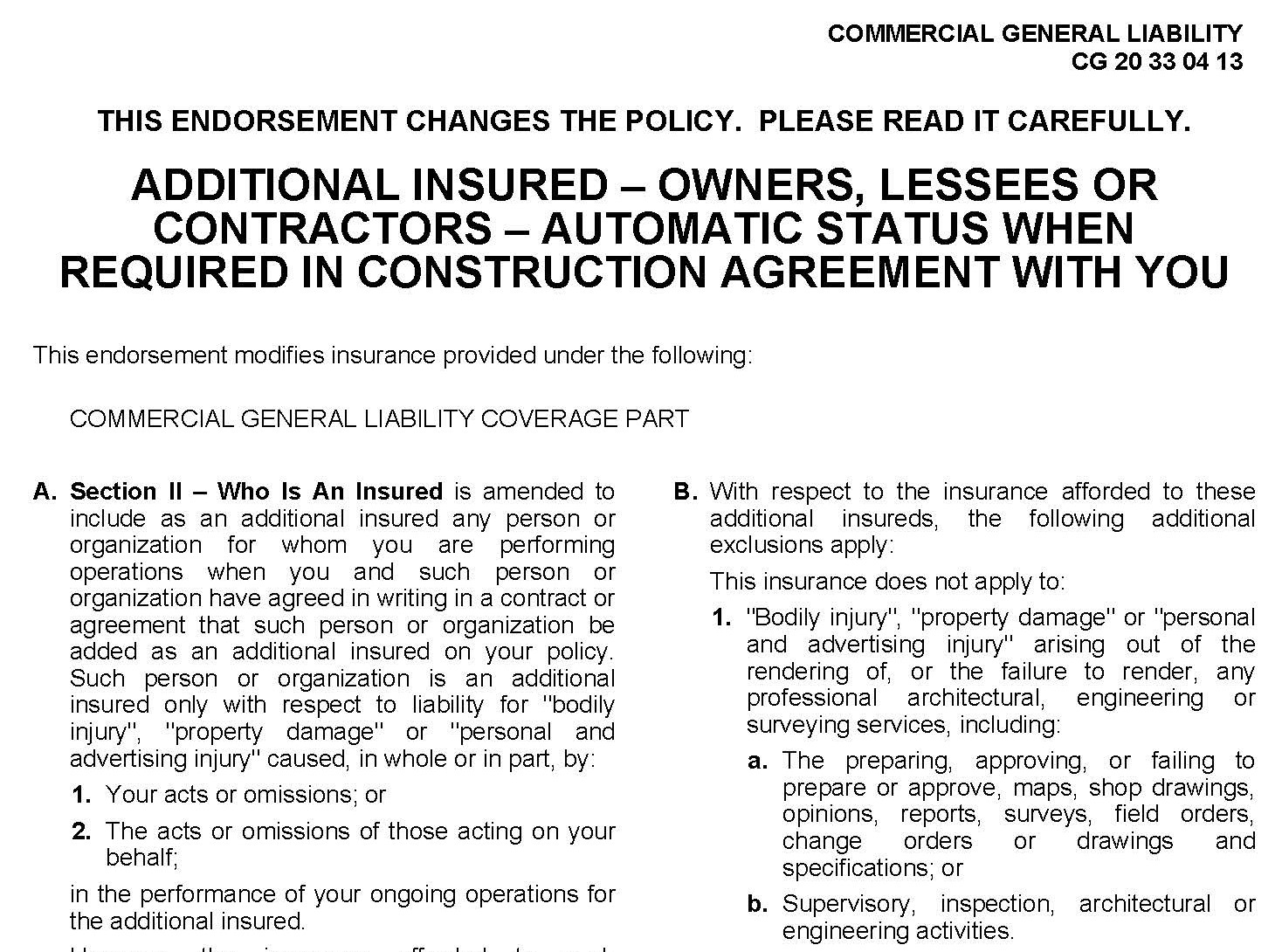
New York courts have held that if the policy contains a CG 20 33-type endorsement and the party seeking additional insured status has no written agreement directly with the purchaser of the insurance, there is no coverage, even if some other agreement provides that the supposed additional insured will receive it. See Gilbane Bldg. Co./TDX Constr. Corp. v St. Paul Fire & Mar. Ins. Co., 143 AD3d 146, 152, 38 NYS3d 1 [1st Dept 2016], aff’d 31 NY3d 131, 74 NYS3d 162, 97 NE3d 711 [2018]; AB Green Gansevoort, LLC v Peter Scalamandre & Sons, Inc., 102 AD3d 425, 426–427, 961 NYS2d 3 [1st Dept 2013]. This is because the endorsement states that additional insured status is only provided when there is a written contract “with you”, and “you” being the named insured. Because, in the above example, the owner does not have a written contract “with you” (i.e., the subcontractor), it does not qualify as an additional insured.
Key takeaway: If you are an owner or upper-tier contractor without a direct agreement with the sub whose policy you’re tendering to, this is the gap insurers commonly exploit. At the drafting stage, require CG 20 10 or an equivalent form that does not condition coverage on privity, or get a direct written agreement with the sub. Do not rely on a CG 20 33-type form in a multi-tier structure where you have no direct contract with the subcontractors or other downstream parties. If the loss has already happened and your contract with the sub only ties to CG 20 33, look for any direct writing, even an informal one, between you and the subcontractor before conceding the point.
Contract Issues: Does the contract require additional insured coverage?
Generally, the provision requiring the named insured to procure coverage for you in the underlying contract must be express and specifically stated. Trapani v. 10 Arial Way Associates, 755 N.Y.S.2d 396, 398 (2nd Dept. 2003). These following cases show how easily a generic insurance clause can fail to do the job:
(1) No coverage, where a contract requiring the named insured to purchase several forms of insurance for itself, without expressly requiring it to name the owner as an additional insured on its general liability coverage, does not create additional insured coverage. 140 Broadway Prop. v. Schindler Elevator Co., 901 N.Y.S.2d 292, 293 (2d Dept. 2010).
(2) No coverage, where a hold-harmless agreement with no requirement to name the owner as an additional insured does not create coverage. Hargob Realty Associates, Inc. v. Fireman’s Fund Ins. Co., 901 N.Y.S.2d 657, 659 (2nd Dept. 2010).
(3) No coverage, where an agreement to obtain liability insurance in one’s own right and separately hold the other party harmless does not create coverage. Mangano v. Am. Stock Exch., Inc., 651 N.Y.S.2d 494, 495 (1st Dept. 1996).
(4) No coverage, where a requirement of “general liability insurance” with “certificates to follow” only requires the named insured to hold its own coverage and provide proof of it — it does not create additional insured status. Trapani v. 10 Arial Way Associates, 755 N.Y.S.2d 396 (2nd Dept. 2003).
(5) No coverage, where a certificate of insurance listing the parties as additional insureds, standing alone, does not create coverage. Chipotle, 158 N.Y.S.3d at 205.
(6) No coverage, where a general clause incorporating the insurance provisions of a prime contract by reference did not create coverage here — though this can be enough if the prime contract itself has specific, on-point terms for the subcontractor. Lexington Ins. Co. v. Kiska Dev. Group LLC, 122 N.Y.S.3d 590, 592 (1st Dept. 2020).
(7) No coverage, where a blanket agreement requiring coverage for “specified owners” did not cover an owner who was not actually specified, even though it owned the property. 77 Water St., Inc. v. JTC Painting & Decorating Corp., 50 N.Y.S.3d 471, 475 (2nd Dept. 2017).
(8) No coverage, where a requirement that the named insured provide certificates of insurance from its subs listing the owner as an additional insured, without more, was not enough. Ramcharan v. Beach 20th Realty, LLC, 942 N.Y.S.2d 593, 597 (2nd Dept. 2012).
(9) No coverage, where a clause making insurance procurement a condition of an owner’s right to withhold payment — rather than an independent, express obligation — did not create coverage. Lexington Ins. Co. v. Kiska Dev. Group LLC, 122 N.Y.S.3d 590, 592 (1st Dept. 2020).
(10) Coverage found, where a contract requiring a “certificate of insurance clearly setting forth the coverage for the equipment and naming [the party] as loss payee and additional insured” was specific enough. United Rentals (N.A.), Inc. v. Conti Enterprises, Inc., 293 F. Supp. 3d 447, 456 (S.D.N.Y. 2018) (applying NY law).
Key takeaway: Every “no coverage” result above traces back to a contract clause that was vague, generic, or conditional. When you are reviewing an existing contract before a loss or drafting the next one, insist on language that expressly says the contractor/subcontractor “shall name [Owner/GC] as an additional insured” under a specific CGL form, on a primary and noncontributory basis. General language just requiring “insurance” will not suffice. A clause incorporating “the insurance requirements of the prime contract” by reference can work, but only if the referenced document actually contains specific, on-point additional insured language for that subcontractor; don’t assume a passing reference is enough.
Identity of party issues — misnamed parties on the contract, policy, or schedule
New York is generally forgiving of naming errors, and courts have held that effectively naming the insured or additional insured is enough. The policy, schedule, or contract does not need to be 100% accurate, so long as it is clearly the same party. The following cases illustrate insurers trying to deny tenders over a technical misnomer, without success:
(1) An insurer could not withhold coverage over an error listing “Court Tobacco Co.” rather than “Court Tobacco Stores, Inc.” Court Tobacco Stores, Inc. v. Great Eastern Insurance Company, 43 A.D.2d 561 (3rd Dept. 1973).
(2) A policy naming the “New York State Department of Social Welfare Commission for the Blind” was equivalent to naming the State of New York. State v. Ins. Co. of N.A., 333 N.Y.S.2d 486 (3d Dept. 1972).
(3) No meaningful difference between “Stoncor Group” and its trade name “Stonhard Corp.” Stoncor Group, Inc. v. Peerless Ins. Co., 322 F. Supp. 3d 505, 508 (S.D.N.Y. 2018).
(4) A subcontract requiring coverage for “Stellar Mechanical Services of N.Y. II” satisfied the requirement for “Stellar Mech. Services of New York, Inc.” Stellar Mech. Services of New York, Inc. v. Merchants Ins. of New Hampshire, 903 N.Y.S.2d 471, 475 (2d Dept. 2010).
(5) An insurer could not withhold coverage over a misidentified named insured where the intent to cover the project’s risk was clear. N.Y. Cas. Ins. Co. v. Shaker Pine, 262 A.D.2d 735, 736 (3rd Dept. 1999).
(6) An insurer’s obligation to cover a mortgage holder’s risk applied even though the mortgage holder was misidentified in the contract. Cheperuk v. Liberty Mutual Fire Insurance Company, 263 A.D.2d 748 (3d Dept. 1999).
(7) Even though only the former landlord was listed as the additional insured, the current landlord was entitled to coverage where the named insured had agreed to insure the landlord and the policy expressly covered the landlord’s risk. 137 Broadway Associates, LLC v. 602 W. 137th Deli Corp., 975 N.Y.S.2d 710 (N.Y. Sup. Ct. 2013).
Key takeaway: If you are the one drafting the subcontract, get entity names right — but don’t panic over minor variations that do slip through. New York courts will look past immaterial misnomers so long as the intended party is clear, as the cases above show.
II. The Duty to Defend
Once you have established additional insured status, the analysis turns to whether the underlying claim is covered, i.e., whether the insurer has an obligation to provide coverage for the additional insured.
There are two distinct duties of an insurance company with respect to providing additional insured coverage: (1) the duty to defend, and (2) the duty to indemnify. The former is an insurance company’s duty to hire attorneys to defend the additional insured in the lawsuit, while the latter is an insurance company’s duty to actually pay for the claimed injury, should the claimant be successful in the lawsuit.
It is well settled under New York law that an insurance company’s duty to defend is “exceedingly broad.” Auto. Ins. Co. of Hartford v. Cook, 7 N.Y.3d 131, 137 (2006). The duty to defend is broader than an insurer’s duty to indemnify. Id.
The scope of an insurer’s duty to provide additional insured coverage depends on the endorsement’s language:
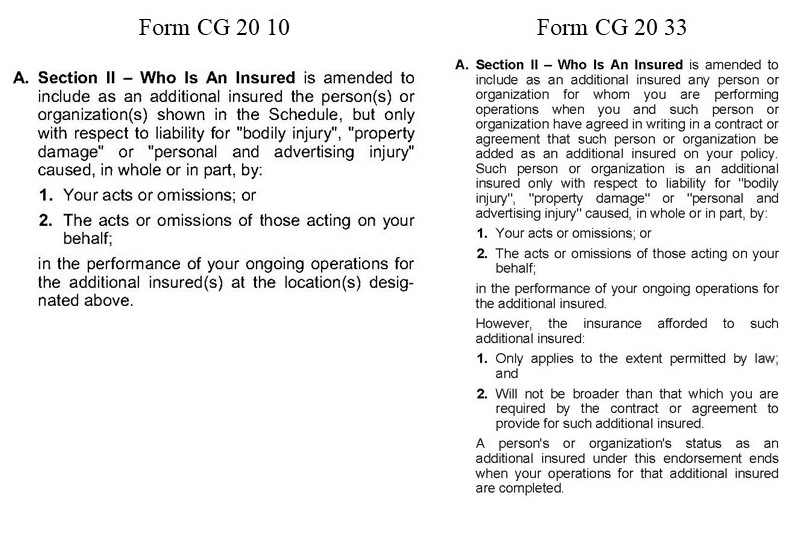
These above common forms provide that there is additional insured coverage for liability “caused, in whole or in part,” by the named insured. In Burlington Ins. Co. v NYC Tr. Auth., the Court of Appeals held that “caused, in whole or in part” means “proximate cause”. 57 N.Y.S.3d 85 (2017)6.
Critically, the Burlington standard is applicable to an insurer’s duty to indemnify its insureds, not the duty to defend. This is because the duty to defend an insured is a much lower bar, and so it is triggered by a claim having only a reasonable possibility of meeting the Burlington standard.7
Therefore, an additional insured does not need to prove the named insured was an actual proximate cause of the claim/injury to be entitled to a defense, as that determination usually waits for a court or jury. Only the possibility of that finding is required to trigger a duty to defend.8 Once triggered, an insurer must defend the additional insured no matter how groundless, false or baseless the suit may be.9
The possibility of coverage, and therefore, the duty to defend, can be triggered in multiple ways in a claim, including where the allegations of a complaint directly “suggest … a reasonable possibility of coverage”; extrinsic evidence outside the complaint suggests the possibility of coverage; or even a third-party complaint – filed by the additional insured, can trigger an insurer’s duty to defend.10
The Burlington standard is commonly weaponized by insurers to avoid providing any coverage to its additional insureds, including providing a defense. This is because once an insurer steps in to defend its additional insured, it cannot withdraw from that defense without a court order11. A common excuse found in tender rejection letters is that the additional insured is not entitled to coverage because there is no proof that the claim/injury was caused by, in whole or in part, the acts or omissions of the named insured. This is a transparent misuse of the Burlington standard and should be challenged by any party seeking additional insured coverage.
Therefore, when tendering to an insurance company, or analyzing an insurer’s response to the tender, review and provide every available fact that would trigger the duty to defend, including:
(a) the pleadings (the named insured need not even be a party — for example, where the plaintiff is the named insured’s employee);
(b) discovery materials (deposition testimony, bills of particulars, etc.);
(c) third-party complaints — including one filed by the party seeking additional insured coverage itself; and
(d) known facts outside the four corners of the complaint, which can help trigger the duty to defend (e.g., a contract showing that the named insured was working on site at the time of the injury); and
(e) importantly, an insurer cannot rely on outside information to escape a defense obligation that the allegations otherwise trigger. Fitzpatrick v. Am. Honda Motor Co., Inc., 575 N.E.2d 90 (1991)
Key takeaway: If an insurer disclaims based on the complaint alone, check whether discovery, a third-party complaint, or facts you already know about the loss would independently support the reasonable-possibility standard and put the insurer on notice of those facts in writing.
III. The Duty to Indemnify
The partner of the duty to defend is the duty to indemnify. Indemnification of a claim means that the insurer will have to pay for the liability of its insureds, if the claimant is successful in the lawsuit. As discussed above, if the additional insured form uses the language “caused, in whole or in part”, under the Burlington standard, this means that the duty to indemnify will trigger only if the named insured was at least a proximate cause of the liability. This can be as little as 1% of the proximate cause. However, because proximate cause is a legal determination, it ultimately requires a judicial finding.
There are some policy forms that use a different trigger than the Burlington language. For example, the term “arising out of”, as seen in the below form, is a broader, alternative trigger. “Arising out of” means “originating from, incident to, or having connection with.” This broader term requires only some causal relationship between the injury and the insured risk to trigger an insurer’s duties12.
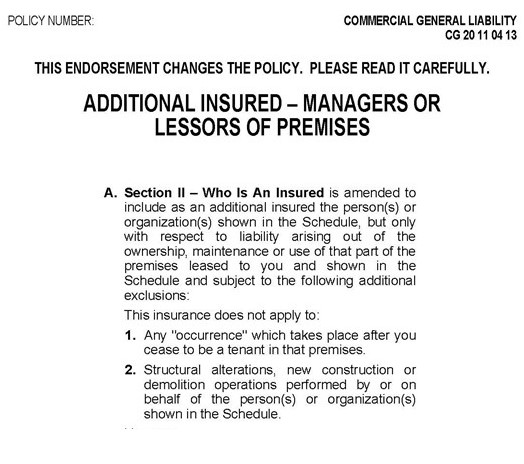
Under the “arising out of” language, the focus of the indemnification trigger is on the general nature of the operation during which the injury occurred, and you do not need to wait for a judicial determination of liability to trigger indemnity under this standard13.
However, even this broader language will not trigger in every circumstance. Two examples where courts found no “arising out of” connection are as follows:
• A subcontractor had finished installing stairs and left the site; the general contractor conceded the staircase was merely the situs of the accident. Worth Const. Co., Inc. v. Admiral Ins. Co., 888 N.E.2d 1043 (2008).
• A bodily injury occurring outside the leased premises did not arise out of the named insured’s performance operations at the premises. Christ the King Regl. High Sch. v. Zurich Ins. Co. of N.A., 937 N.Y.S.2d 290, 294 (2nd Dept. 2012).
IV. Conditions and Exclusions
Even when a claim otherwise triggers additional insured coverage, certain policy terms, conditions, or exclusions can stop coverage for an event. Some of these conditions, terms, or exclusions may be imposed on the named insured, and some on the additional insured.
Conditions
Conditions in insurance policies can be express or implied.14 Express conditions are those agreed to and imposed by the parties themselves. In an insurance context, express conditions “must be literally complied with before a party to the contract may recover.” If a condition is a “condition precedent”, that condition must occur before an insurer has any obligation to perform its duties. More so, if there is a “condition precedent”, an insurer only needs to show that the condition was not met to avoid coverage, it does not need to show that it was prejudiced by the insured’s failure to meet that condition. A condition precedent usually but not always states that it is a condition precedent.
A common policy condition is that an insured must notify the insurer as soon as possible after it discovers or is notified of a claim, or that an insured must cooperate with the insurer. An example of a condition precedent is where a named insured must require its subcontractors to name it as an additional insured in their policies (and that the policy states that such requirement is a condition precedent).
That said, a named insured’s breach of a policy condition — including a condition precedent, such as late notice or lack of cooperation — is not grounds for disclaiming coverage to an additional insured.15 This means that if the named insured breached a policy condition by, for example, failing to notify the insurer of a claim until very late, an additional insured would still be entitled to coverage under that policy, even though the named insured was excluded from coverage for its failure to satisfy a condition.
Therefore, an insurer cannot point to the named insured’s own missteps in handling the claim to deny your separate coverage. (A breach of a condition by the additional insured itself is a different matter and can be grounds for denial.)
However, some acts of the named insured may still invalidate coverage for the additional insured. Usually, these types of breaches invalidate the entire policy. An example of this would be if the named insured had a material misrepresentation in the application of the policy. If the insurer can prove this, and that they were prejudiced by that misrepresentation, they may be allowed to void the entire policy, ab initio, or stated otherwise, make it as if the policy was never issued in the first place. So there would not be any additional insured coverage under the policy because there was no policy in the first place. That is because “additional insureds, by definition, must exist in addition to something; namely, the named insureds in a valid existing policy.”16
Exclusions
An exclusion is a policy term that seeks to exclude coverage for an otherwise covered event. These differ from conditions in that conditions can apply before coverage may be applied, while exclusions only apply after coverage for a claim is triggered.
Whether an exclusion applies to an additional insured depends entirely on the policy’s wording, usually, whether the policy uses the language “the insured” or “any insured.”
• “The insured” limits a condition or exclusion to the particular insured it describes, or to the particular insured seeking coverage;
• “Any insured” (or “an insured”) binds all insureds to the consequences of any one insured’s act;
• The “named insured” is limited only to the named insured on the policy declarations.
These terms are commonly found in exclusions for an employee injury. For example, if an exclusion states that it applies for injury to an employee of the insured, the exclusion only bars coverage for the specific insured who actually employed the plaintiff, but it will not apply for an additional insured who was not the employer. If the same exclusion is written for an employee of “any insured”, then the exclusion bars coverage for all insureds, named and additional alike, if any of them employed the injured person.17 Therefore, some exclusions that would apply to one insured, may not apply to another.
Key takeaway: Always read the exact article of the exclusion the insurer is relying on. If it says “the insured” and the excluded conduct or relationship belongs only to the named insured, that exclusion should not reach you.
V. Insurance Law § 3420(d) & Denial Letters
Insurance Law §3420(d) is a strong tool for any insured. This statute applies to any liability policy that provides coverage with respect to a claim arising out of the death or bodily injury of any person.18 This provision outlines the requirements of an insurer’s response to a claim (arising out of bodily injury), such as a tender response, denial letter, reservation of rights, etc. Critically, “failure to comply with section 3420(d) precludes denial of coverage based on a policy exclusion.”19 So an insurer’s procedural defect under this provision can invalidate its entire position and waive its right to rely on policy exclusions.
• The basic requirement of Section 3420(d)(2) is that an insurer shall give written notice as soon as is reasonably possible of any denial letter to the insured and the injured person or any other claimant.
The determination of what is “as soon as reasonably possible” is generally fact specific, as not all the grounds for an exclusion will be available at the outset of a claim. Timeliness of insurer’s disclaimer of liability is measured from time when insurer first learns of grounds for disclaimer or denial of coverage20.
That said, “where the sole ground upon which the disclaimer is based is obvious from the face of the notice of claim and accompanying complaint, a delay of even 30 days has been held to be unreasonable.”21 If the grounds for a disclaimer are obvious, an insurer will have to provide an acceptable excuse for its delay, or else it will waive its right to deny the claim22.
An example of this is where an insurer denies coverage to a named insured, and months later, an additional insured tenders for coverage. If the insurer denies the tender on the same grounds as it denied the named insured’s claim, it will have no excuse for a late denial letter (because the grounds for its disclaimer were already obvious by virtue of its disclaimer to the named insured).
• Section 3420(d)(2) requires that a disclaimer letter include, “with a high degree of specificity,” the ground or grounds on which the disclaimer is predicated.23 If a disclaimer letter does not specify a certain ground for its denial, the insurer will waive its right to rely on that ground for excluding coverage.24
A disclaimer letter must “identify the applicable policy exclusion and set forth the factual basis for the insurer’s position that the claim fell within a policy exclusion, with sufficient specificity to satisfy the statutory mandate and purpose.”25 That said, a small misquotation or a partial omission of the policy language of an exclusion does not invalidate it automatically, so long as the letter is otherwise sufficiently specific on the exclusion’s application.26 If an insurer denies coverage on one ground, then it will have waived all other grounds for denial (that were available at that time).
• Section 3420(d)(2) applies to additional insureds.27 Under New York law, additional insureds are entitled to the same protections as a named insured, including timely notice of disclaimer.28
• Section 3420(d)(2) requires the insurer to send disclaimer notice directly to the additional insured (or its counsel), and failure to do so precludes the insurer from disclaiming based on an exclusion.29 A letter sent only to the additional insured’s own insurer does not satisfy § 3420(d)(2).30
• A copy of the disclaimer sent to the named insured can satisfy § 3420 — but only if that letter specifically addresses coverage for the additional insured (e.g., “therefore, there is no coverage available under the Policy for this claim for any party, including any additional insureds”). If a disclaimer only addresses the named insured’s own coverage, the disclaimer letter will not apply to the additional insured.
• A reservation of rights letter does not constitute compliance with the requirements of section 3420(d).31
• 3420(d) applies whether the policy of insurance is primary or excess.32
Any failure on any of these points is an independent basis to challenge the denial, separate from the merits of coverage.
When tendering a claim on your behalf, confirm the package includes:
• Identification of who is tendering and on whose behalf;
• The named insured and the specific policy being tendered to (if available);
• The claim documentation (complaint, notice of loss, etc.);
• The contract or agreement connecting you to the named insured, matched against the endorsement’s exact requirement (contract vs. written contract vs. executed written contract, and scheduled vs. blanket basis); and
• A letter invoking the triggering language for the duty to defend with supporting facts (from the pleadings, discovery, or otherwise).
If you are drafting or negotiating a contract with a contractor, subcontractor, or any downstream party, build these protections into the contract before the work or contract begins:
• Express, specific language that the subcontractor “shall name [Owner/GC] as an additional insured”, on a primary and noncontributory basis, with specific limits. Make sure not to only use generic language requiring only that the sub “maintain insurance”;
• A fully executed contract, signed by both parties before work begins;
• State the specific additional insured endorsement form (e.g., CG 20 10), covering both ongoing and completed operations; and
• Ensure that additional downstream entities do not require direct privity-of-contract, such as in a CG 20 33-type endorsement.
* * *
Aboulafia Law Firm LLC works exclusively on behalf of policyholders and has decades of experience fighting insurance companies. Whether you are dealing with a residential or commercial property claim, we are ready to help you. If you are seeking to obtain additional insured coverage or are dealing with a tender, don’t navigate the complex claims process alone. For assistance on your insurance claim, please contact us.
The opinions expressed are those of the author(s) and do not necessarily reflect the views of the firm, its clients, or any of its or their respective affiliates. This article is for general information purposes and is not intended to be and should not be taken as legal advice.
Aaron Jacob is a senior associate at Aboulafia Law Firm LLC. Mr. Jacob is a skilled litigation and coverage attorney and has extensive experience representing commercial and private clients involved in property damage and insurance coverage claims in complex state and federal court matters.
Mr. Jacob focuses his practice on advocating for policyholders in high-exposure property damage cases, insurance recovery claims, coverage disputes, construction-related claims, declaratory judgments, first & third-party claims, business interruption losses, indemnification, additional insured coverage, broker negligence, risk transfer, contractor/subcontractor liability, bad faith claims, contribution claims, breach of contract disputes, and general liability defense, as well as in litigating insurance coverage issues under several policy lines including homeowners, commercial liability, excess/umbrella, businessowners, cargo, freighting, and commercial auto policies.
Footnotes
1. Tribeca Broadway Associates, LLC v. Mt. Vernon Fire Ins. Co., 774 N.Y.S.2d 11, 13 (1st Dept. 2004). ↩
2. This specific endorsement form is usually the most lenient and advantageous for additional insureds. ↩
3. Chipotle Mexican Grill, Inc. v. RLI Ins. Co., 158 N.Y.S.3d 201, 205 (2nd Dept. 2021) (“agreement” or “contract”); Zurich Am. Ins. Co. v. Endurance Am. Speciality Ins. Co., 43 N.Y.S.3d 40, 41 (1st Dept. 2016) (“written contract”); Nicotra Group, LLC v. Am. Safety Indem. Co., 850 N.Y.S.2d 455, 457 (1st Dept. 2008) (“executed written contract”). ↩
4. Direct privity of contract can also be required under Form CG 20 10, depending on the language used in the schedule. E.g., if the schedule purports to only provide coverage for people that “you agreed with” in a contract, some courts may interpret that language as requiring direct privity of contract. Under this language, the analysis is comparable to CG 20 33. ↩
5. See, above. ↩
6. An alternative trigger to “caused, in whole or in part,” is “arising out of”, discussed later. ↩
7. See Live Nation Mktg., Inc. v. Greenwich Ins. Co., 135 N.Y.S.3d 87, 89 (1st Dept. 2020); Indian Harbor Ins. Co. v. Alma Tower, LLC, 87 N.Y.S.3d 9, 10 (N.Y. App. Div. 1st Dept. 2018) (“because there is a reasonable possibility that [the named insured] proximately caused the injury…”). ↩
8. Citizens Ins. Co. of Am. v. Am. Ins. Co., 130 N.Y.S.3d 289, 290 (1st Dept. 2020) ↩
9. Automobile Ins. Co. of Hartford v. Cook, 850 N.E.2d 1152, 1155 (2006). ↩
10. Id.; see also, Wesco Ins. Co. v. Hellas Glass Works Corp., 2020 NY Slip Op 06975, ¶ 1, 188 A.D.3d 621, 621, 132 N.Y.S.3d 758, 758 (App. Div. 1st Dept. 2020); One Reason Rd., LLC v. Seneca Ins. Co., Inc., 83 N.Y.S.3d 235, 238 (2nd Dept. 2018); All State Int. Demolition Inc. v. Scottsdale Ins. Co., 92 N.Y.S.3d 256, 257 (1st Dept. 2019); Indian Harbor Ins. Co. v. Alma Tower, LLC, 165 AD3d 549, 549 (1st Dept 2018); Greater New York Mut. Ins. Co. v. State Natl. Ins. Co., Inc., 120 N.Y.S.3d 578 (N.Y. Sup. Ct. 2019); Travelers Prop. Cas. Co. of Am. v. Harleysville Ins. Co. of N.Y., 128 N.Y.S.3d 154 (Sup. Ct. 2020) (rejecting an insurer’s argument that a third-party complaint cannot be relied upon to establish a duty to defend). ↩
11. Seye v. Sibbio, 821 N.Y.S.2d 473 (2d Dept. 2006) ↩
12. Regal Constr. Corp. v National Union Fire Ins. Co. of Pittsburgh, PA, 15 NY3d 34, 38, 930 N.E.2d 259, 904 N.Y.S.2d 338 (2010) ↩
13. Hunter Roberts Const. Group., LLC v. Arch Ins. Co., 75 AD3d 404, 408 (1st Dept. 2010) ↩
14. Oppenheimer & Co. v. Oppenheim, Appel, Dixon & Co., 636 N.Y.S.2d 734, 660 N.E.2d 415, 418 (1995); Seaport Park Condo. v. Greater New York Mut. Ins. Co., 828 N.Y.S.2d 381, 384 (1st Dept. 2007). ↩
15. 233 E. 17th St., LLC v. L.G.B. Dev., Inc., 913 N.Y.S.2d 110, 112 (2nd Dept. 2010). ↩
16. Admiral Ins. Co. v. Joy Contractors, Inc., 19 N.Y.3d 448, 461 (2012) ↩
17. Moleon v. Kreisler Borg Florman Gen. Const. Co., Inc., 758 N.Y.S.2d 621, 624 (1st Dept. 2003); Sixty Sutton Corp. v. Illinois Union Ins. Co., 825 N.Y.S.2d 46, 49 (1st Dept. 2006); Soho Plaza Corp. v. Birnbaum, 969 N.Y.S.2d 96, 100 (2d Dept. 2013). ↩
18. This statute does not apply, however, to claims, for example, for property damage or business interruption losses. ↩
19. Matter of Worcester Ins. Co. v Bettenhauser, 95 NY2d 185, 188, 734 N.E.2d 745, 712 N.Y.S.2d 433 (2000) ↩
20. Allcity Ins. Co. v Jimenez, 78 N.Y.2d 1054, 576 N.Y.S.2d 87, 581 N.E.2d 1342, (1991) ↩
21. Gagosian Gallery, Inc. v. Eurostruct, Inc., 814 N.Y.S.2d 890 (N.Y. Sup. Ct. 2005) citing West 16th Street Tenants Corp. v. Pub. Service Mut. Ins. Co., 736 N.Y.S.2d 34 (1st Dept. 2002). ↩
22. Id., see also AIU Ins. Co. v. Veras, 942 N.Y.S.2d 532, 533 (1st Dep’t 2012); Sirius Am. Ins. Co. v. Vigo Const. Com., 852 N.Y.S.2d 176, 178 (2d Dep’t 2008) (finding 34-day delay unreasonable as a matter of law where no explanation was provided). ↩
23. Gen. Accident Ins. Grp. v. Cirucci, 46 N.Y.2d 862, 414 N.Y.S.2d 512, 387 N.E.2d 223, 225 (1979). ↩
24. Id., see also Zappone v. Home Ins. Co., 55 N.Y.2d 131, 135 (1982) ↩
25. Adams v. Perry’s Place, 168 A.D.2d 932, 564 N.Y.S.2d 1019, 1019 (1990). ↩
26. Id. ↩
27. See Sierra v 4401 Sunset Park, LLC, 957 N.Y.S.2d 219 (2d Dept 2012), affd 25 N.E.3d 921 (2014); Matter of Worcester Ins. Co. v Bettenhauser, 95 NY2d 185, 188, 734 N.E.2d 745, 712 N.Y.S.2d 433 (2000). ↩
28. Id. ↩
29. Sierra v. 4401 Sunset Park, LLC, 24 N.Y.3d 514, 2 N.Y.S.3d 8 (2014). ↩
30. Id. (“The obligation imposed by the Insurance Law is to give timely notice to the mutual insureds … not to … another insurer”). ↩
31. Zappone v. Home Ins. Co., 55 N.Y.2d 131, 135 (1982). ↩
32. Id. ↩